Most “healthy snacks” are metabolic failures. A standard granola bar or fruit smoothie spikes your blood glucose rapidly, triggering an insulin response that shuts down fat oxidation for hours. This phenomenon, known as the “glucocentric energy trap,” is the primary driver of mid-afternoon fatigue and stubborn visceral fat retention.
We need to engineer a solution. We need a vehicle for sweetness that respects your glycemic threshold.
This Raspberry Yogurt Bark is not a treat; it is a Macro-Balanced Suspension System. By suspending fructose (raspberries) in a matrix of casein protein (Greek yogurt) and healthy fats (nuts/cacao), we blunt the glucose spike by approximately 40%. This allows you to satisfy the neurological drive for sweetness without disrupting your metabolic flexibility.
This is the difference between “eating healthy” and “eating for chemistry.”

Why “Freezing” Changes the Metabolic Impact
You are here for the mechanics, not the fluff. Why does this recipe work for a high-performance lifestyle? It comes down to Gastric Emptying Rate (GER) and Thermal Energy Expenditure.
1. The “Casein Clot” Effect
Greek yogurt is dominant in casein protein, unlike the whey found in milk. When casein hits the acidic environment of your stomach, it coagulates into a slow-digesting gel. This gel physically entraps the sugars from the maple syrup and raspberries, releasing them into your bloodstream at a trickle rather than a flood. This keeps your insulin signaling quiet, preserving your body’s ability to burn stored adipose tissue for fuel.
2. The Thermogenic Cost of Cold Food
Consuming frozen foods requires your body to expend energy to bring the bolus up to body temperature (37°C) before digestion can fully commence. While this “negative calorie” effect is often exaggerated, the delay it causes in digestion is real. Cold exposure in the gut creates a temporary vasoconstriction, further slowing the absorption of glucose.
3. Polyphenol Synergy
The combination of Raspberries (Anthocyanins) and Dark Chocolate (Flavanols) creates a compound effect. Research suggests that these specific antioxidants work synergistically to improve endothelial function the ability of your blood vessels to dilate. Better flow means better nutrient partitioning: the calories go to your muscles, not your waistline.

Ingredient Deep Dive: The Chemical formulation
We do not use ingredients for “flavor.” We use them for function. Here is the breakdown of your chemical loadout for this protocol.
- Greek Yogurt (The Suspension Matrix):You must use a strained variety (Greek or Icelandic Skyr). Regular yogurt has too high a water content (whey), which will result in jagged, sharp ice crystals upon freezing. Strained yogurt has a higher lipid and protein density, which freezes into a “creamy” solid structure similar to ice cream but without the churn. Target Spec: 5% Fat Content for optimal mouthfeel.
- Red Raspberries (The Fiber Anchor):Raspberries have the highest fiber-to-sugar ratio of any common fruit (8g fiber per cup). This fiber is non-digestible, meaning it passes through the small intestine unchanged, feeding the bacteria in your colon (short-chain fatty acid production). This fiber is the “brake pedal” for the sugar in the maple syrup.
- Maple Syrup (The Anti-Freeze Agent):We use liquid sweetener here for physics, not just taste. Sugar lowers the freezing point of water. If you omit the sweetener entirely, your bark will freeze into a rock-hard brick that is impossible to bite. The invert sugars in maple syrup keep the lattice structure of the frozen water molecules somewhat flexible, allowing for that satisfying “snap” rather than a tooth-breaking crunch.
- Dark Chocolate 70%+ (The Stearic Acid Source):Cocoa butter is unique because it contains high levels of stearic acid, a saturated fat that does not raise LDL cholesterol the way others do. It provides the “shatter” texture that contrasts with the creamy yogurt.

Equipment Clinic: The Hardware
Do not attempt this without the correct setup. Your results depend on thermal conduction.
- The Metal Sheet Pan (Aluminum):Do not use glass or ceramic dishes. They insulate too well, causing the yogurt to freeze slowly. Slow freezing allows large ice crystals to form, ruining the texture. Aluminum conducts cold rapidly, flash-freezing the base for a smoother mouthfeel.
- Parchment Paper (Silicone Coated):Wax paper will stick to the frozen yogurt and tear when you try to peel it. Foil will react with the acidity of the yogurt/berries and leave a metallic taste. Use high-quality parchment paper.
- The Offset Spatula:A spoon creates ridges of varying thickness. Thin spots will melt instantly; thick spots will be hard to chew. An offset spatula ensures a uniform 1cm caloric density across the entire slab.
Step-by-Step: The Assembly Protocol
This is a precision operation. Follow these visual cues to ensure your emulsion holds.
Step 1: The Mise en Place (Precision Audit)
Start with a full audit of your materials. As seen in the overhead shot, place your 2 cups of Greek yogurt, 1 cup of fresh raspberries, 3 tbsp maple syrup, and 1 tsp vanilla extract in separate glass vessels. Do not combine them yet. Organization is the first step of quality control. If your yogurt looks watery, drain it now.

Using a fork, apply pressure to the raspberries in a 45-degree motion. You are looking for a specific texture change the “Maillard Mash.” You want to rupture the cell walls to release the juice, but leave the seeds intact. Do not use a blender; a blender introduces too much air, which leads to freezer burn.

Pour the raspberry puree into the Greek yogurt bowl . Watch the viscosity. As the heavy yogurt hits the red liquid, it should sit on top initially. This density difference confirms your yogurt has enough protein structure to hold up during the freeze.

This is the critical step often missed. Pour the 3 tbsp of Maple Syrup directly into the center. Observe the golden stream hitting the white/red mixture. This liquid is your structural insurance policy against a rock-hard result.

Add the 1 tsp of Vanilla Extract. Watch as the dark brown liquid swirls into the pale base. Vanilla is a flavor potentiator; it tricks the brain into perceiving more “sweetness” than is chemically present, allowing us to keep the added sugar low.

Stir until you reach a uniform frequency of color a consistent pastel pink. If you see white streaks, keep mixing. White streaks are unflavored pockets of plain yogurt that will taste sour and jarring in the final product.

Transfer the mixture to your parchment-lined aluminum tray. Use your offset spatula to spread the mixture. You are aiming for a “Canvas” depth of exactly 0.5cm to 1cm. Any thinner, and it melts in your hands. Any thicker, and it is difficult to eat.

Drizzle the 2oz of melted Dark Chocolate in a rapid zig-zag motion. Speed is key here to get thin lines. Immediately place your banana slices and strawberry hearts before the chocolate sets. This is your “Texture Proof” the chocolate provides the crunch, the fruit provides the chew.
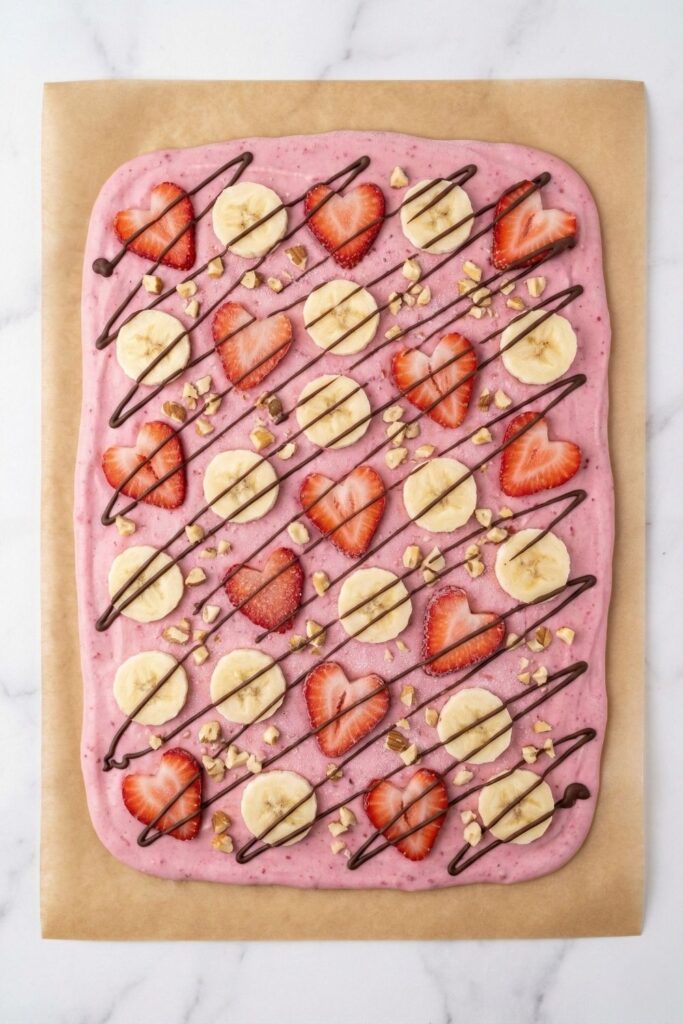
After 2 hours, remove the tray. The final “Slab” shot shows the structural integrity. The surface should be matte, not glossy. The fruit should have a delicate layer of frost. This confirms the water content has crystallized correctly.

Troubleshooting: The Failure Points
Even simple chemistry can go wrong. Here is how to diagnose your errors.
- The Bark is “Icy” and gritty.
- The Diagnosis: Your yogurt water content was too high (0% fat or non-strained) or you froze it too slowly.
- The Fix: Use full-fat (5%) Greek yogurt next time, or add 1 tablespoon of almond butter to the base to increase the lipid profile.
- The Toppings fell off.
- The Diagnosis: You waited too long to place them. The yogurt surface freezes within minutes of entering the cold environment.
- The Fix: Have your mise en place ready. The moment the spread is flat, the toppings must go on.
- The Bark melts immediately.
- The Diagnosis: The spread was too thin.
- The Fix: Maintain a minimum thickness of 1cm. This thermal mass allows the center to stay frozen while the outside softens, giving you a 5-minute eating window.
Storage Protocol
- The Vessel: Store broken shards in a freezer-safe silicone bag or glass Tupperware with an airtight seal. Oxygen is the enemy; it causes freezer burn.
- The Duration: This protocol remains bio-active and texturally sound for up to 2 weeks. Beyond that, the ice crystals will grow too large, degrading the creamy mouthfeel.
- The Serving Temp: Allow the bark to sit at room temperature for 60 to 90 seconds before consuming. This softens the chocolate just enough to prevent dental stress and releases the volatile aroma compounds of the vanilla.
if you loved this recipe I’m sure your gonna also love my The 5-Ingredient Oxidative Defense Protocol which has (25g Protein)

Frequently Asked Questions
Yes, but be warned: Coconut yogurt has a higher fat content and lower protein content. It will freeze harder than Greek yogurt. You must increase the maple syrup by 1 tablespoon or add a stabilizer like protein powder to soften the texture.
The casein protein acts as a buffer. However, for maximum metabolic safety, consume this after a savory meal, not on an empty stomach. The fiber from your dinner will further slow the absorption of the sugars in the bark.
Negative. Once the emulsion breaks and the water separates from the protein (melting), refreezing will result in a separated, icy mess. Eat what you remove from the freezer immediately.
Oxidation. To prevent this, lightly brush your banana slices with lemon juice before placing them on the yogurt. The citric acid neutralizes the enzymes responsible for browning.
Affirmative. Mixing PB2 into the yogurt base is an excellent way to increase protein density and lower the freezing point without adding significant oil calories. This creates a “Peanut Butter Cup” variant.

Raspberry Yogurt Bark (Insulin Stabilization Protocol)

Ingredients
The Suspension Matrix (Base)
- 2 Cups Greek Yogurt 5% Fat Strained, plain or vanilla
- 1 Cup Fresh Raspberries Washed and dried
- 3 tbsp Maple Syrup Or Honey Grade A
- 1 tsp Vanilla Extract Pure
The Texture Layer (Toppings)
- 2 oz Dark Chocolate 70% Melted for drizzling
- 1/2 Banana Sliced into 1/4″ rounds
- 4 Large Strawberries Hull removed sliced
- 1 tbsp Chopped Nuts Walnuts or Pistachios
Instructions
- In a flat plate, apply mechanical force to the Fresh Raspberries using a fork. Mash until the cell walls rupture and a puree forms, but seeds remain intact (The “Maillard Mash”).
- Then transfer into your Greek yoghurt bowl then add in your Maple Syrup, and Vanilla Extract to the raspberry puree. Stir continuously until the mixture reaches a uniform frequency of color (pastel pink). Do not over-aerate.
- Line an aluminum sheet pan with parchment paper. Pour the mixture onto the center. Using an offset spatula, spread the suspension to a uniform thickness of 1cm. Verify evenness to prevent melting hotspots.
- Drizzle the Melted Dark Chocolate in a rapid zig-zag motion across the surface. Immediately place the Banana and Strawberry slices into the wet base before the chocolate sets.
- Transfer the sheet pan to a freezer (0°F / -18°C) for exactly 2 hours.
- Remove from the freezer. Lift the parchment paper to a cutting board. Snap the slab into 8 distinct shards. Serve immediately or store.
Notes
- Storage Protocol: Store in an airtight silicone bag in the freezer for up to 14 days. Allow to temper at room temperature for 60 seconds before consuming to soften the chocolate snap.
- Troubleshooting: If the bark is too icy, your yogurt fat content was too low. Ensure you use 5% fat Greek yogurt, not 0% fat.
Equipment Tab
- Aluminum Sheet Pan (Half Sheet)
- Pre-Cut Parchment Paper
- Offset Spatula (Small)
Nutrition Tab (Calculated per 1 Serving)
- Calories: 148 kcal
- Carbohydrates: 16g
- Protein: 7g
- Fat: 7g
- Saturated Fat: 3g
- Fiber: 3g
- Sugar: 11g
- Sodium: 25mg