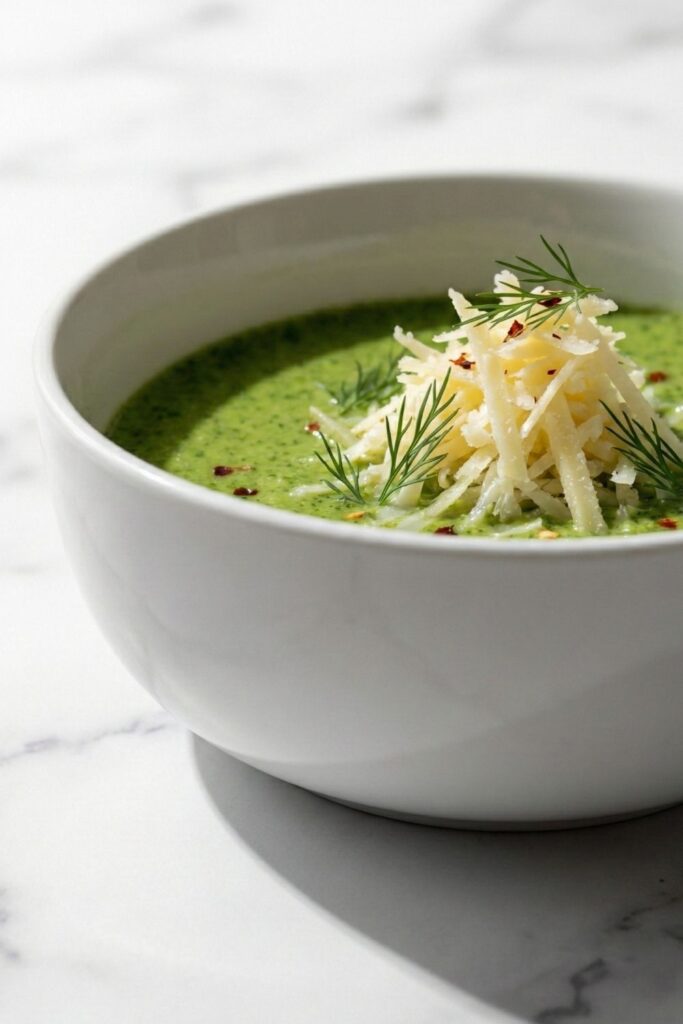
Most broccoli soups are essentially flavored water thickened with heavy cream. They offer zero metabolic advantage.
This formula is different.
By utilizing the chemical reaction between roasted brassicas and acidified dairy proteins, we create a soup that is hyper-satiating and metabolically active. We are not just making lunch; we are engineering a meal that triggers the Thermic Effect of Food (TEF).
The result?
A 246-calorie bowl that feels like 600, keeps your insulin stable, and tastes like a cheat meal.
Let’s get into the physics of why this works.

The Science: Thermogenesis & Emulsification
Why does this specific combination of ingredients yield such a high Return on Investment (ROI) for your body? It comes down to two biological mechanisms: Protein Leverage and Sulforaphane Activation.
1. The Thermic Effect of Food (TEF)
Calories are not created equal.
Protein requires 20-30% of its total caloric energy just to be digested. This is the “Thermic Effect.” By combining Casein (from the cottage cheese) and Albumin (from the bone broth), we stack different protein structures that digest at varying rates.
This keeps your metabolic fire burning longer than a standard carbohydrate-heavy soup.
2. Sulforaphane Production
Broccoli contains a precursor called glucoraphanin. When you damage the cell walls of the broccoli (by cutting it into uniform florets) and subject it to heat (roasting), you trigger an enzymatic reaction that creates Sulforaphane.
This compound is extensively studied for its ability to lower inflammation and support the gut barrier. However, boiling broccoli kills the enzyme myrosinase needed for this conversion.

3. The Emulsification Matrix
Most soups use starch (roux) or heavy fat (cream) to create texture.
We are using Shear Stress Emulsification.
By blasting the roasted feta (a fat structure) and cottage cheese (a protein structure) in a high-horsepower blender, we force the fat globules to disperse evenly into the bone broth. The result is a suspension that mimics the mouthfeel of heavy cream without the caloric density.
This is fluid dynamics, not cooking.
Ingredient Deep Dive: Chemical Properties
To replicate the texture shown in my Shred Happens analysis, you cannot substitute blindly. Every ingredient has a specific functional role.
The Broccoli (Brassica oleracea)
- Target Spec: Fresh heads, firm stalks.
- The Variable: Moisture Content. Frozen broccoli releases too much water during roasting, preventing the Maillard reaction (browning). You must use fresh broccoli to get the char. The char provides the smoky flavor profile that cuts through the rich cheese.
- Measurement: 5 Cups (450g) of florets.
The Feta Cheese (Sheep/Goat Milk)
- Target Spec: Block feta in brine.
- The Why: Pre-crumbled feta is coated in cellulose (wood pulp) and potato starch to prevent clumping. These anti-caking agents inhibit melting and will leave your soup with a gritty, sandy texture.
- Chemistry: Block feta has a higher moisture content, allowing it to “slump” and caramelize in the oven rather than drying out.

The Cottage Cheese (Curds)
- Target Spec: 4% Milkfat (Small Curd).
- The Function: This is your secret thickening agent. It is rich in Casein protein. Unlike whey, which is thin, casein coagulates and thickens when blended, giving the soup “body.”
- Temperature: It must be added COLD. This shocks the hot vegetables and prevents the blender motor from overheating the mixture, preserving the bright green color.
The Bone Broth (Liquid Base)
- Target Spec: Chicken or Beef Bone Broth (High Gelatin).
- The Why: Look for broth that gels when refrigerated. That gelatin adds viscosity to the soup when warm. Water or vegetable stock lacks this collagen structure and will result in a thinner, more watery final product.

Equipment Clinic: The Hardware
You are only as good as your tools.
1. The High-Performance Blender
- Requirement: Minimum 1200 watts (e.g., Vitamix, Ninja, Wolf Gourmet).
- The Physics: You need enough torque to pulverize the fibrous stalks of the broccoli and the skin of the onion. A standard smoothie blender will leave “pulp,” ruining the velvet mouthfeel.
2. The Roasting Vessel
- Requirement: Dark metal or ceramic roasting pan.
- The Physics: Dark pans absorb heat; glass pans reflect it. To get the specific “Maillard” char at 415°F, a dark metal pan is superior. If using glass, you may need to extend cooking time by 5-8 minutes.
3. The Scale
- Requirement: Digital Kitchen Scale.
- The Why: Volume measurements (cups) are notoriously inaccurate for broccoli florets. 450g is 450g. Precision matters for the macronutrient profile.
Step-by-Step: The Protocol
Follow these visual cues strictly. Do not deviate.

Break the 2 heads of broccoli down into uniform 1-inch florets.
Technical Note: Uniformity is critical. If some pieces are 2 inches and others are 0.5 inches, the small ones will burn before the large ones are tender. You need equal thermal load.
The florets should be dry to the touch. Any surface moisture will cause steaming, not roasting.

Arrange the 450g of broccoli, quartered yellow onion, and 4 garlic cloves in the pan. Place the 6oz block of Feta in the corner or center do not break it yet.
Drizzle exactly 1.5 tbsp of Olive Oil over the vegetables. Massage it in with your hands. Every floret must have a micro-coating of oil to conduct heat.
Apply 1 tsp oregano, 1 tsp chili flakes, salt, and pepper now. Heat activates the essential oils in the dried herbs.

Roast at 415°F (212°C) for exactly 30 minutes.
Look at the image above. See the dark brown, crispy tips on the broccoli? See how the feta has slumped and turned golden on the edges? This is non-negotiable. If it looks pale, leave it in for 5 more minutes.
The smell should shift from “sulfur” (raw broccoli) to “nutty and sweet” (roasted broccoli).

Transfer the hot roasted contents (oil and all) into the blender jug.
The Stack:
- Hot Veg/Feta (Bottom)
- 3 Cups Bone Broth (Middle)
- 1/2 Cup Cold Cottage Cheese (Top)
- 2 Cups Fresh Spinach (Raw)
- Zest/Juice of 1/2 Lemon.
Why Raw Spinach? We add the spinach raw to preserve the chlorophyll. The residual heat of the soup will wilt it instantly without turning it brown.

Start on Low, then ramp quickly to High. Blend for 45-60 seconds.
Watch for the “Vortex” (the tornado shape in the center). The liquid must fold over itself aggressively to incorporate the air.
Stop when the color is a uniform electric green and no distinct flecks of spinach remain.

Pour immediately. The consistency should resemble heavy cream or melted ice cream thick, opaque, and glossy.
If you love high protein recipes like this check out my Viral Sweet Potato & Cottage Cheese Bowl
Troubleshooting Guide: The “Fix It” Logic
Even with a manual, variables change. Here is how to debug your soup.
The soup is grainy or gritty.
- Diagnosis: The blender run time was too short, or the broccoli stalks were too fibrous.
- The Fix: Pass the entire soup through a fine-mesh sieve. Discard the pulp. For next time, increase blend time by 30 seconds or peel the broccoli stalks before roasting.
The soup is too brown/olive green (not bright green).
- Diagnosis: Thermal degradation of chlorophyll. You either cooked the spinach or the soup got too hot in the blender.
- The Fix: There is no color fix for this batch (flavor will still be good). Next time, ensure your cottage cheese is fridge-cold and do not roast the spinach.
The soup tastes “flat” or heavy.
- Diagnosis: Lack of Acidity. The fat from the feta and cottage cheese is coating the tongue, masking the flavor.
- The Fix: Add another squeeze of lemon juice or a teaspoon of apple cider vinegar. Acid cuts fat and “wakes up” the palate.

It is too thin/watery.
- Diagnosis: Hydrostatic pressure variance. Your broccoli might have had high water content, or you used a low-collagen broth.
- The Fix: Add 1/4 cup more cottage cheese and blend again. The casein will tighten the structure.
Serving & Storage Protocols
The Plating Strategy
Use a wide, shallow bowl. Pile the shredded Manchego in the center so it doesn’t sink immediately. Crack fresh black pepper on the rim, not just the soup.
The “Meal Prep” Protocol
- Storage: Glass airtight containers are mandatory. Plastic containers will stain and retain the sulfur smell of the broccoli.
- Shelf Life: 4 Days in the refrigerator.
- Reheating: Microwave in 45-second intervals, stirring in between. Do not boil on the stove, or the cheese emulsion may break (separate).

FAQs: Common Inquiries
Technically yes, but texturally no. Dairy-based emulsions (feta/cottage cheese) tend to become “grainy” when thawed because the water crystallizes and breaks the protein bonds. Fresh is best. If you must freeze, blend it with a splash of fresh warm broth upon thawing to re-emulsify.
To maintain the high protein/creamy profile without dairy, swap the Feta for a block of “Silken Tofu” (roasted) and the Cottage Cheese for soaked “Cashews” or a high-quality vegan cream cheese. However, note that the protein count will drop significantly unless you supplement with collagen powder in the broth.
The 1 tsp of red chili flakes blooms in the oven heat. If you are sensitive to capsaicin, reduce this to 1/4 tsp or omit entirely. The heat is intended to boost metabolism (thermogenesis), but it is not essential for the texture.
Absolutely. The net carb count is incredibly low (approx 10g) because the bulk of the volume comes from fiber (broccoli/spinach) and liquid (broth). The macro ratio fits perfectly into a ketogenic metabolic state.

High Protein Broccoli Feta Soup (Metabolic Reset)

Ingredients
The Roast (Maillard Reaction)
- 5 cups 450g Broccoli florets (fresh heads only, cut into uniform 1-inch pieces)
- 6 oz Block Feta Cheese in brine, do not use crumbles
- 1 Large Yellow Onion peeled and quartered
- 4 Garlic Cloves whole, peeled
- 1.5 tbsp Olive Oil Extra Virgin
- 1 tsp Dried Oregano
- 1 tsp Red Chili Flakes adjust for heat tolerance
- 1 tsp Kosher Salt
- 1/2 tsp Black Pepper freshly cracked
The Emulsification (Blender)
- 3 cups Chicken Bone Broth must gel when cold for best viscosity
- 1/2 cup Cottage Cheese 4% Milkfat, small curd – must be COLD
- 2 cups Baby Spinach fresh, raw
- 1/2 Lemon Zest and Juice
The Finish (Garnish)
- 1 tbsp Fresh Dill chopped
- 2 tbsp Manchego or Parmesan Cheese finely shredded
- 1 pinch Red Chili Flakes
Instructions
- Preheat your oven to 415°F (212°C). While the oven heats, break down the broccoli into uniform 1-inch florets. Uniformity is critical to ensure the broccoli roasts at the same speed as the onion without burning.
- In a dark metal roasting pan, arrange the broccoli florets, onion wedges, and garlic cloves. Place the 6oz block of Feta directly in the center or corner of the pan.
- Drizzle the vegetables and cheese with 1.5 tbsp Olive Oil. Sprinkle evenly with oregano, chili flakes, salt, and pepper. Use your hands to massage the oil onto the florets. Roast for 30 minutes. You are looking for deep browning (char) on the broccoli tips and golden edges on the feta.
- Remove the pan from the oven. Immediately transfer the hot roasted vegetables, melted feta, and all pan oils into your high-speed blender canister.
- Add the 3 cups of Bone Broth, 1/2 cup COLD Cottage Cheese, 2 cups raw Baby Spinach, and the zest/juice of half a lemon. Adding the cottage cheese cold prevents the mixture from overheating the blender motor and preserves the bright green chlorophyll of the spinach.
- Secure the lid. Blend on LOW for 10 seconds, then increase to HIGH for 45-60 seconds. Watch for a “vortex” to form in the center. Stop when the soup is electric green and completely smooth (no visible spinach flecks).
- Pour immediately into bowls. Top with fresh dill, a pinch of chili flakes, and shredded Manchego. The texture should resemble heavy cream.
Notes
Storage Protocol:
Store in airtight glass containers in the refrigerator for up to 4 days. Do not freeze, as the dairy emulsion may break and become grainy upon thawing.Reheating:
Microwave in 45-second intervals, stirring in between. Do not boil on the stove; high heat will cause the cottage cheese proteins to separate.Troubleshooting Texture:
- Too Thick? Add water or extra broth 1 tablespoon at a time.
- Too Grainy? Your blender speed wasn’t high enough, or the broccoli stalks were too fibrous. Pass through a fine-mesh sieve if desired.
Dietary Modifications:
- Dairy-Free: Swap Feta for Roasted Tofu and Cottage Cheese for soaked Cashews (texture will vary).
- Lower Sodium: Reduce salt to 1/2 tsp if your bone broth is salted.
Equipment
- High-Performance Blender (Min 1200 Watts)
- Digital Kitchen Scale
- Chef’s Knife
Nutrition Information
(Calculated per 1 of 4 servings)- Calories: 246
- Fat: 14g
- Saturated Fat: 6g
- Carbohydrates: 10g
- Fiber: 4g
- Sugar: 3g
- Protein: 19.5g
- Sodium: 680mg
- Potassium: 420mg