The Fiber Gap Protocol
Are you part of the 95%?
Statistically, nearly every American is failing a critical biological test every single day: The Fiber Gap.
The FDA recommends 28g of fiber daily. The average intake is barely 15g.This deficit isn’t just about digestion. It is the silent driver of metabolic stagnation, insulin resistance, and chronic, low-grade inflammation. When your gut microbiome lacks substrate (fiber), your metabolic machinery grinds to a halt. Energy crashes. Cravings spike. The body holds onto visceral fat.
This is not just a parfait.
This is a High-Utility Metabolic Tool.
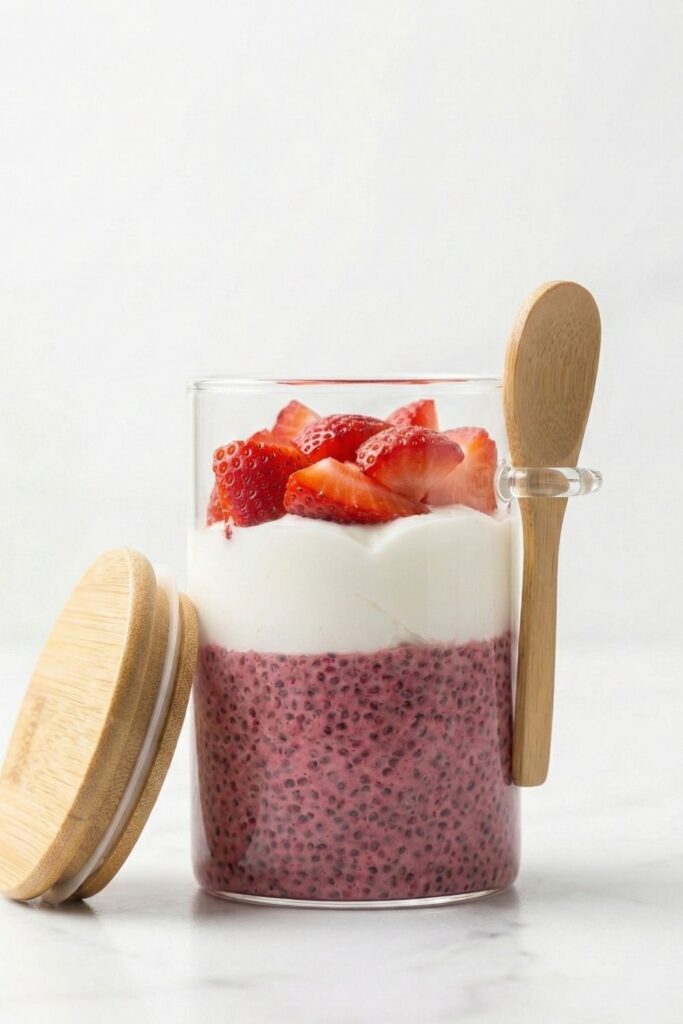
By engineering a precise “Hydrocolloid Suspension” of chia seeds and blending the fruit into the binding liquid, we create a nutrient vehicle that delivers 14g of fiber and 20g of protein in a single vessel. This recipe is designed to act as a “Fiber Firewall,” coating the upper intestine to slow glucose absorption and blunt the insulin response of your next meal.
We are fixing the texture issue, too. Most chia puddings fail because of poor hydration dynamics seeds sinking, liquid separating.
We are fixing that today.
The Science: Hydrocolloids & The Glucose Curve
Why “Mixing” Isn’t Enough.
To understand why this recipe works for metabolic health, we must look at the physics of the Chia Mucilage.
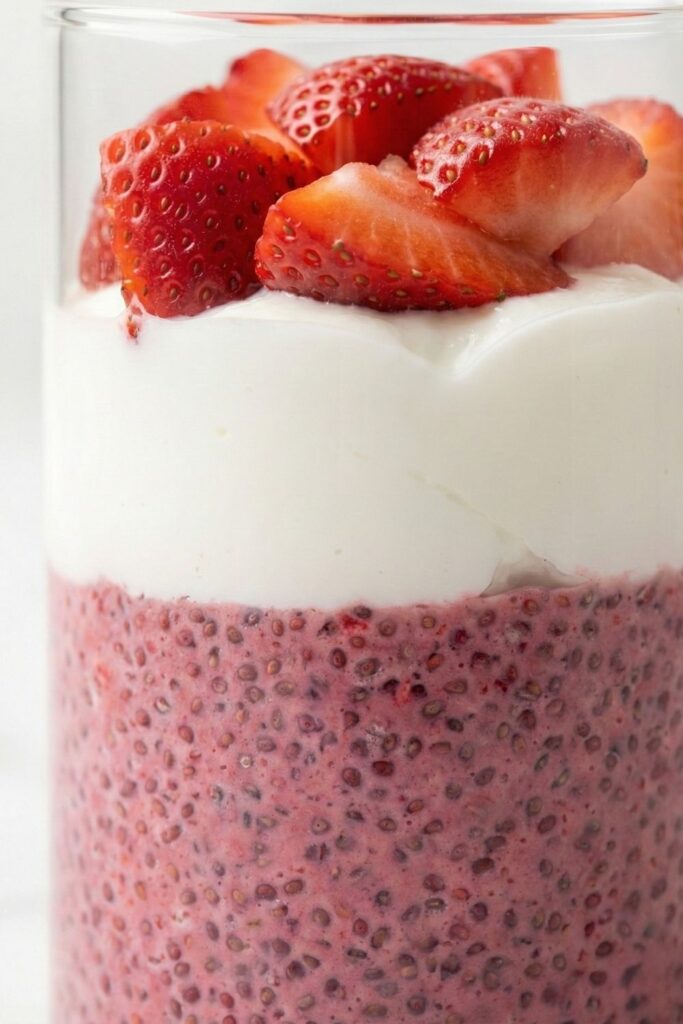
Chia seeds are hydrophilic (water-loving). They can absorb up to 12 times their weight in liquid. When submerged, the outer layer of the seed coat exudes a polysaccharide slime called mucilage. This is a hydrocolloid a substance that forms a gel in the presence of water.
The “Gel Matrix” Effect.
When you eat this specific density of gel, it doesn’t just digest; it hydrates. In your stomach, this gel matrix expands, physically activating stretch receptors that signal satiety (fullness) to your brain via the vagus nerve.
The “Fiber Firewall.”
The blending technique we use here is critical. By pulverizing the raspberries into the oat milk before adding the seeds, we release pectin (a soluble fiber) from the fruit cell walls.
This creates a Double-Matrix:
- Pectin Chain: Thickens the liquid immediately.
- Chia Gel: Thickens the liquid over time.
This viscosity increases the “Transit Time” in your gut. It forces your body to digest carbohydrates slower, preventing the sharp blood sugar spike that typically follows a sweet breakfast. You get steady, flat-line energy instead of a crash.
Ingredient Deep Dive: The Bio-Availability Data
We select ingredients based on their chemical utility, not just flavor.
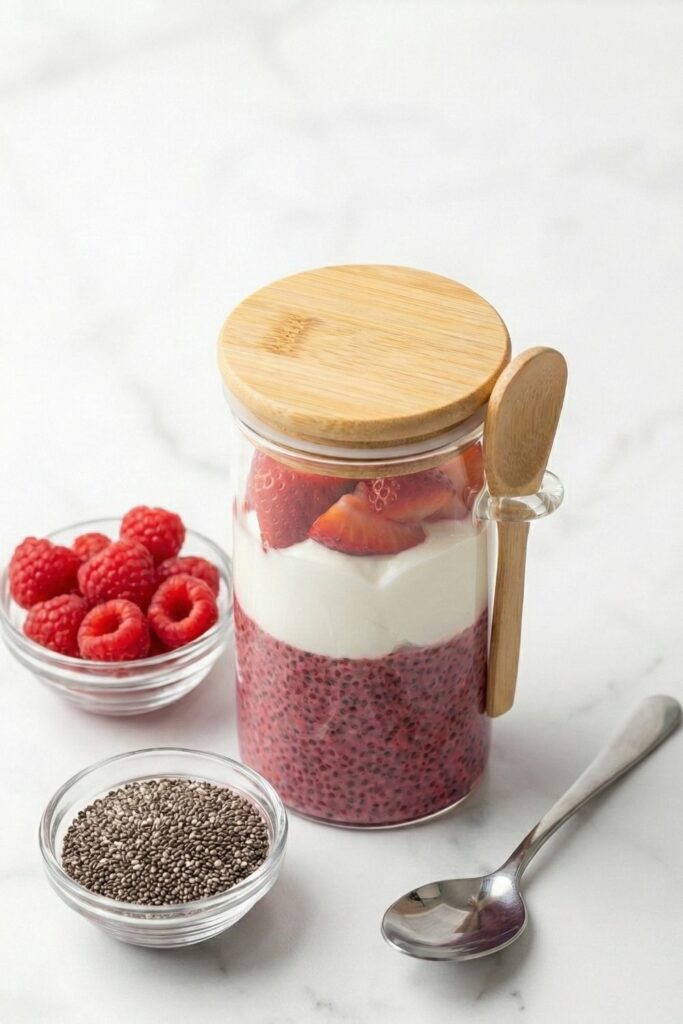
1 Chia Seeds (Salvia hispanica)
- The Spec: Black or White varieties (nutritionally identical).
- The Stat: 40% Fiber by weight.
- The Utility: High in Alpha-Linolenic Acid (ALA), a plant-based Omega-3. However, the outer shell is tough. By soaking them for a minimum of 1 hour (as dictated in the Troubleshooting section), we soften the hull, improving the bioavailability of the internal fats.
- Why Not Flax? Flax seeds must be ground to be digested. Chia seeds can be digested whole if fully hydrated.
2. Raspberries (Frozen vs. Fresh)
- The Spec: IQF (Individually Quick Frozen) Raspberries.
- The Chemistry: We prefer frozen for the base because the freezing process ruptures the cell walls. When thawed/blended, they release more juice and anthocyanins (the red pigment) than fresh berries, creating a stronger emulsion with the oat milk.
- The Glycemic Load: Raspberries have the highest fiber-to-sugar ratio of almost any fruit. One cup contains 8g of fiber.
3. Oat Milk (The Solvent)
- The Spec: Unsweetened, “Barista Blend” preferred.
- The Utility: Oat milk contains beta-glucans, another form of soluble fiber linked to cholesterol reduction.
- The Texture: We use oat milk over almond milk here because of its higher starch content. The starch granules swell when mixed with the chia, contributing to a creamier “mouthfeel” that mimics dairy pudding without the saturated fat.
4. Greek Yogurt (The Protein Cap)
- The Spec: 0% or 2% Plain Greek Yogurt.
- The Utility: Casein protein. Unlike whey, which digests fast, casein clots in the stomach and digests slowly. This pairs perfectly with the slow-digesting chia seeds to keep you anabolic (muscle-sparing) for hours.
Equipment Clinic: The Precision Setup
1. The High-Speed Blender
- Requirement: Minimum 1500 watts.
- Why: You need to liquefy the raspberry seeds. If you use a weak blender, you will have crunchy bits in your smooth pudding. We want a homogenous emulsion.
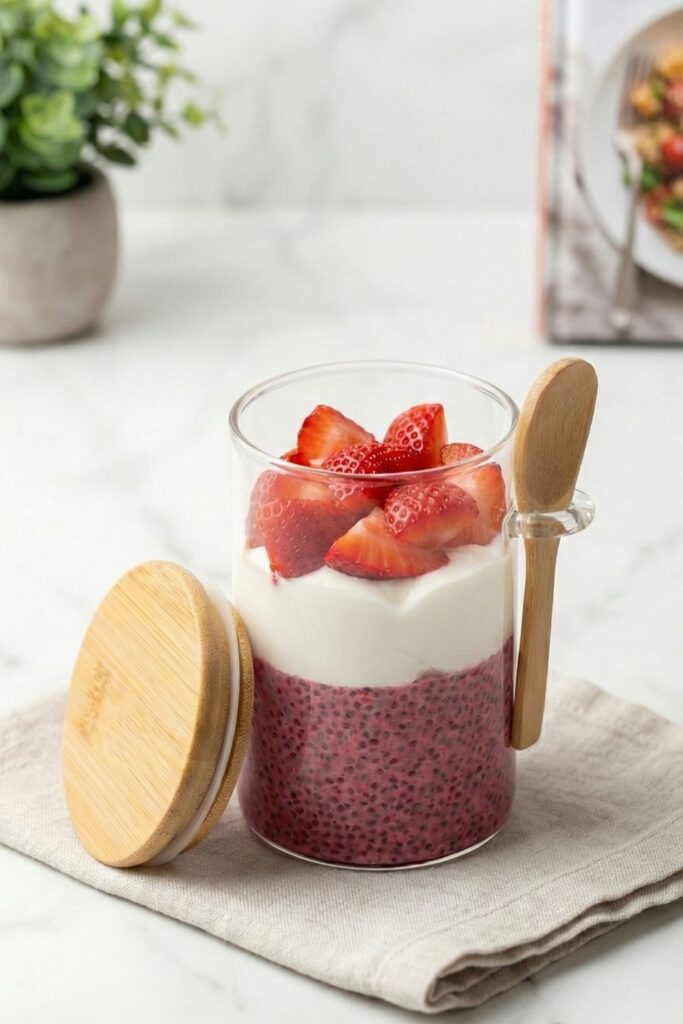
2. The Borosilicate “Overnight” Jars
- Requirement: 16oz capacity, straight-walled.
- Why: Straight walls are mandatory for the “Layering” effect. Tapered jars (like mason jars with necks) make it difficult to spoon the yogurt layer evenly without smearing the glass.
- The Lid: Bamboo with silicone seal. This is crucial for the “Oxygen Barrier.” Chia seeds contain volatile oils (fats) that can go rancid if exposed to air. The airtight seal preserves freshness for up to 5 days.
The Silicone Spatula
Requirement: Flexible edge.
Why: To scrape down the sides of the mixing bowl during the “Second Stir.”
Step-by-Step: The Technical Execution
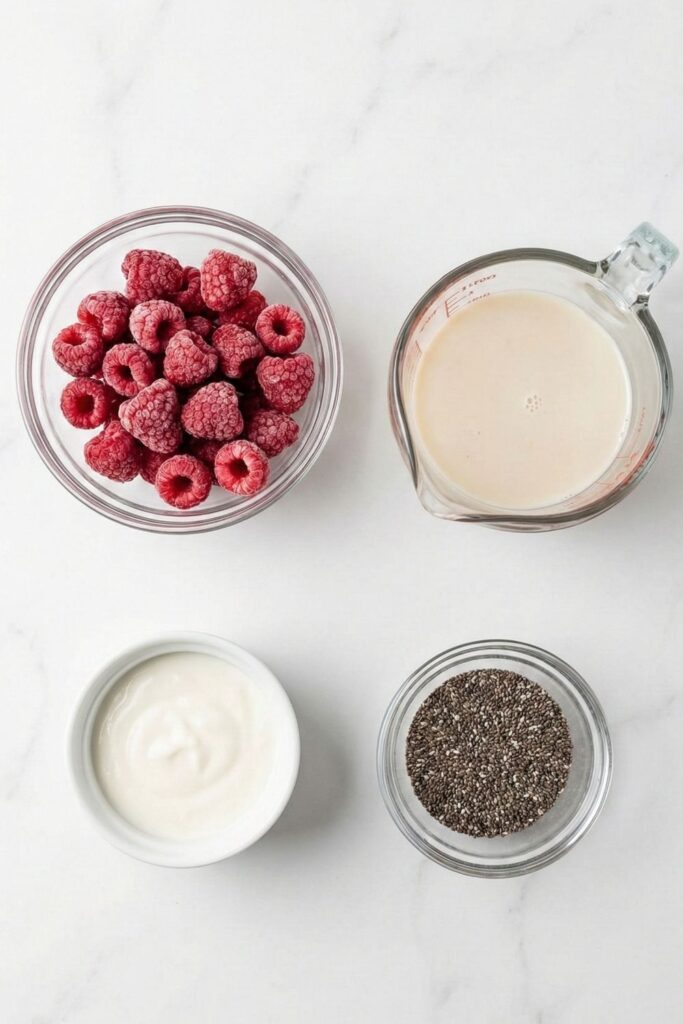
Setup your “Lab Bench.” Arrange your clear vessels on the white counter. You need 1 cup of frozen raspberries, 1 cup of oat milk (check the meniscus line on the jug), 1/4 cup yogurt, and 1/4 cup dry chia seeds.
The raspberries should still be frosty. Do not let them thaw completely, or they lose their structural integrity before blending.
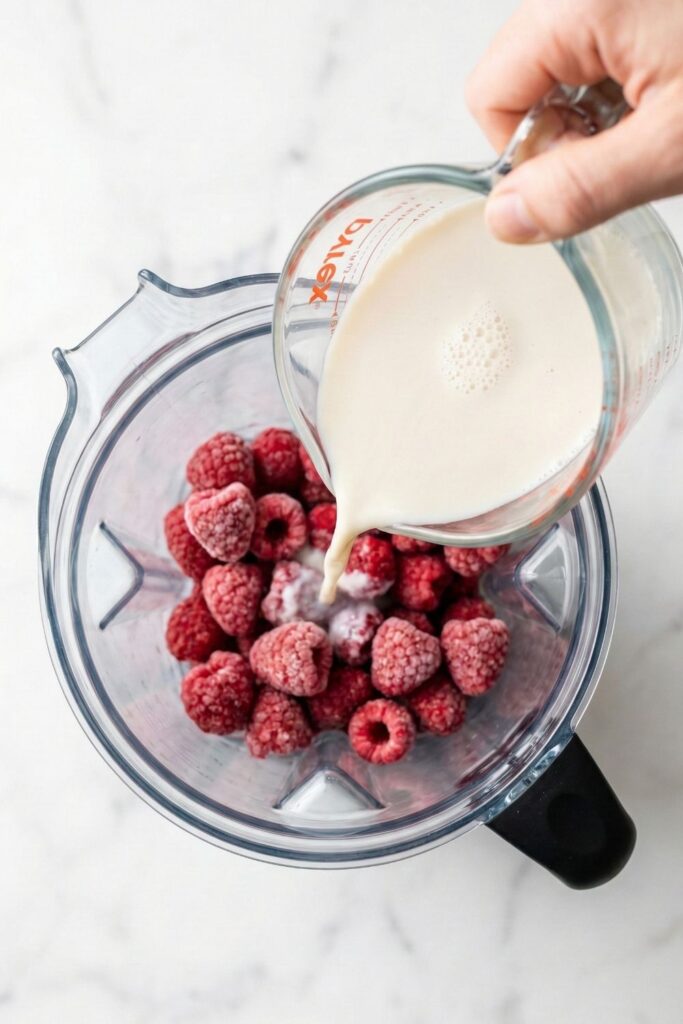
Pour the oat milk over the raspberries in the blender canister. Blend on HIGH for 30 seconds. The liquid will turn a vibrant, opaque neon pink.
Stop the blender. Dip a spoon in. Are there visible fruit chunks? If yes, blend for another 15 seconds. The liquid must be viscous and smooth, like heavy cream.
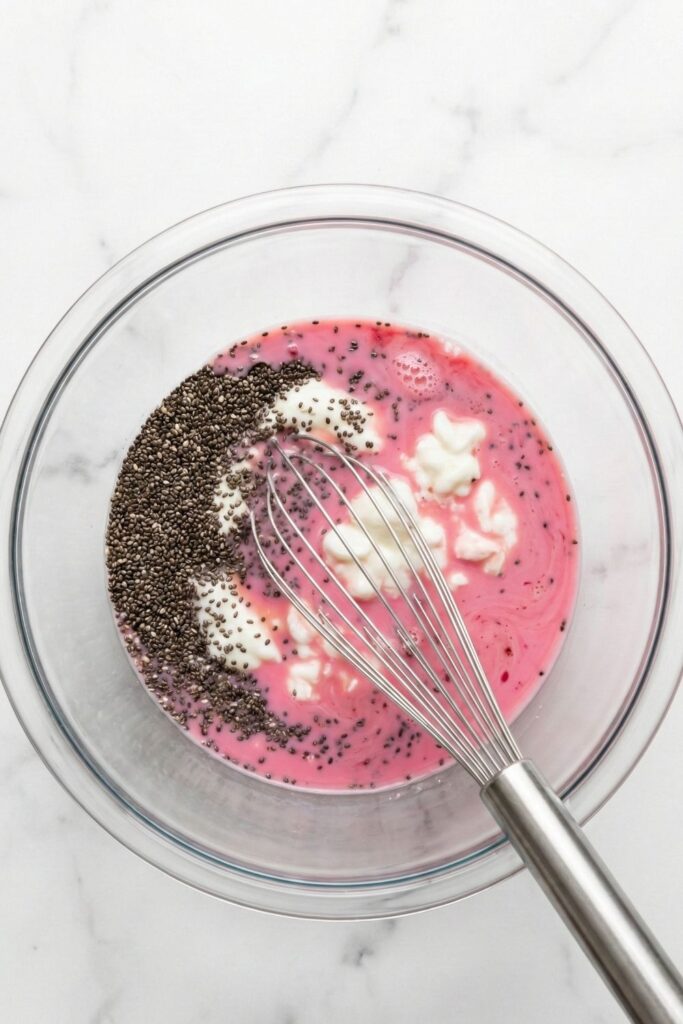
Pour the pink raspberry-milk emulsion into a large mixing bowl containing the dry chia seeds and the first 1/4 cup of yogurt. Whisk immediately.
This is the most critical visual moment. Initially, the seeds will swirl chaotically. You will see streaks of white yogurt, pink milk, and black seeds.
Whisk until the color is uniform a consistent pastel pink. Do not stop until the yogurt streaks are gone.
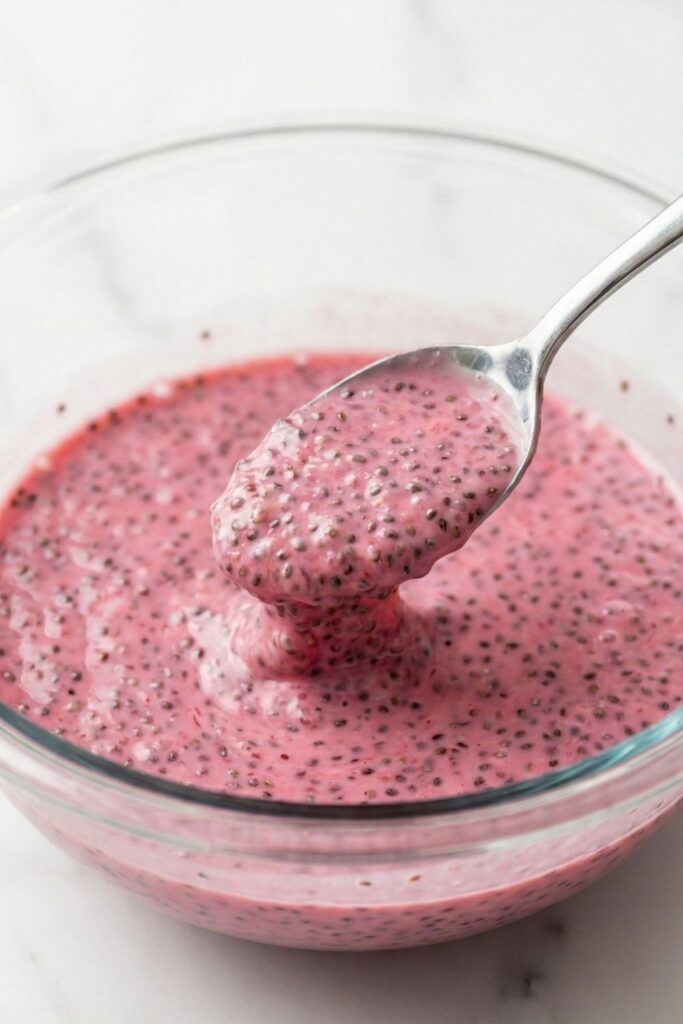
Set a timer for 3 minutes. Walk away. Do not touch the bowl.
The Science: Gravity is pulling the heavy seeds down. The mucilage is just starting to form.
After 3 minutes, STIR AGAIN. Lift the whisk. The mixture should no longer look like “soup.” It should look like “batter.” The seeds should be suspended in the liquid column, not sinking to the bottom. If they sink, the gel hasn’t set. Stir for 30 more seconds.
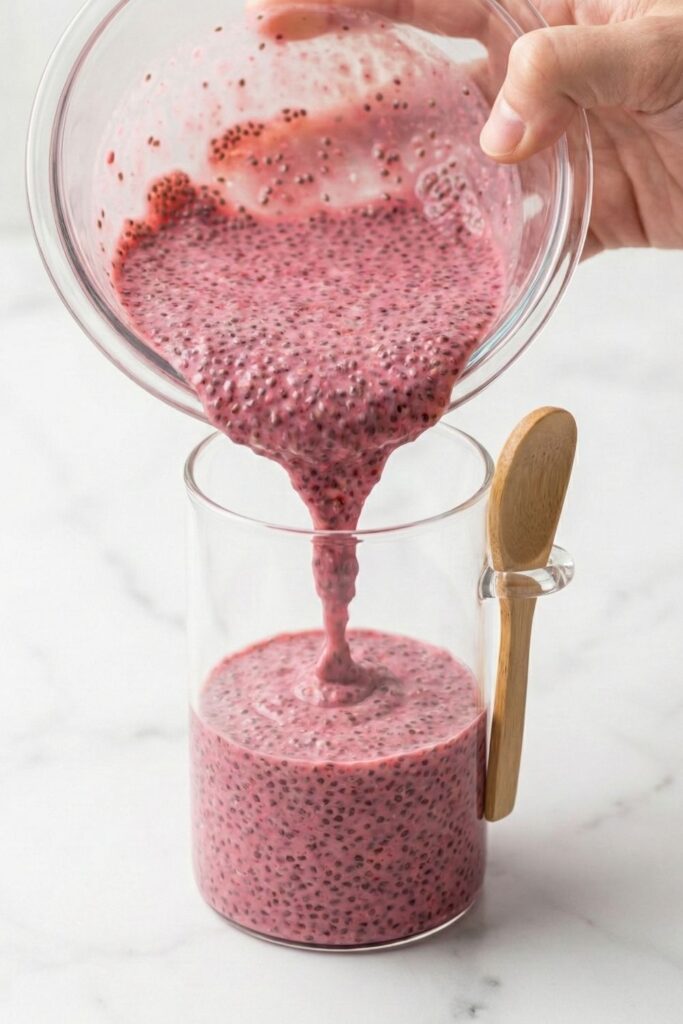
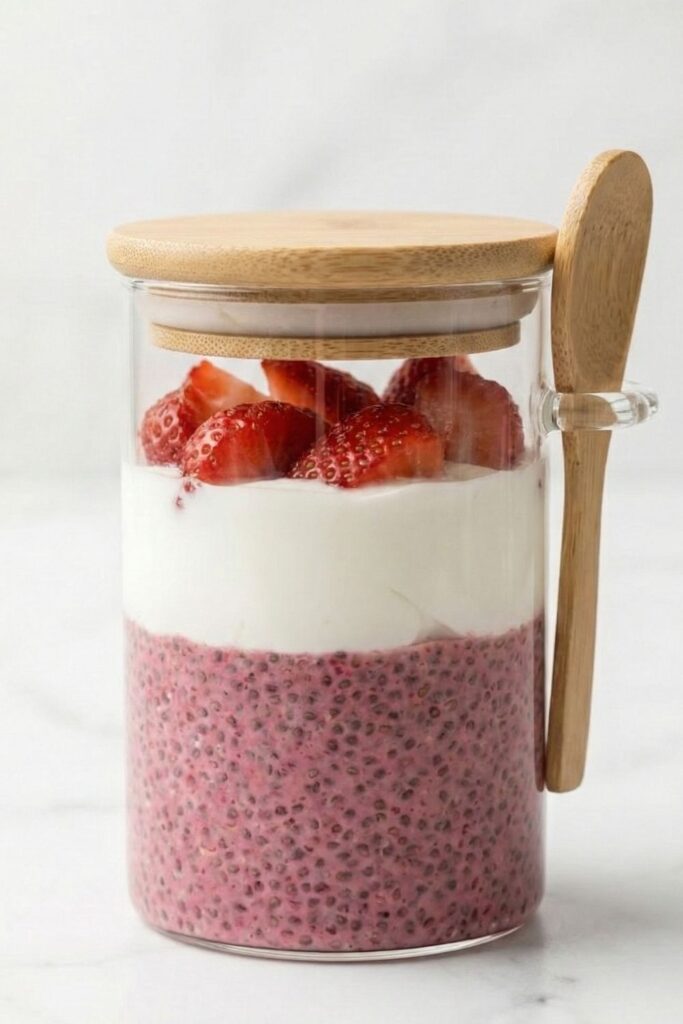
Pour the thickened pink mixture into your glass jars, filling them exactly 60% of the way.
Look at the side of the jar. The pink line should be flat and clean. If you splashed pink on the upper glass walls, wipe it with a paper towel. The aesthetic relies on clean separation.
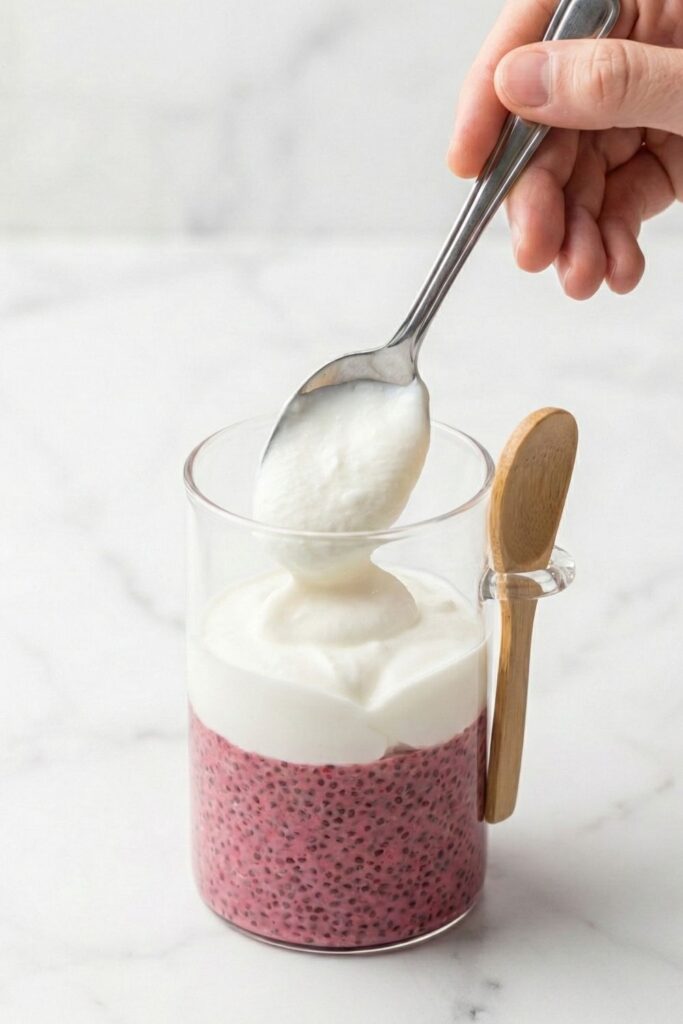
Using a tablespoon, gently dollop the remaining Greek Yogurt on top of the pink layer.
Spread it to the edges to create a solid White Band. This is your visual “Pattern Interrupt.” The contrast between the neon pink and the stark white signals “freshness” to the brain.
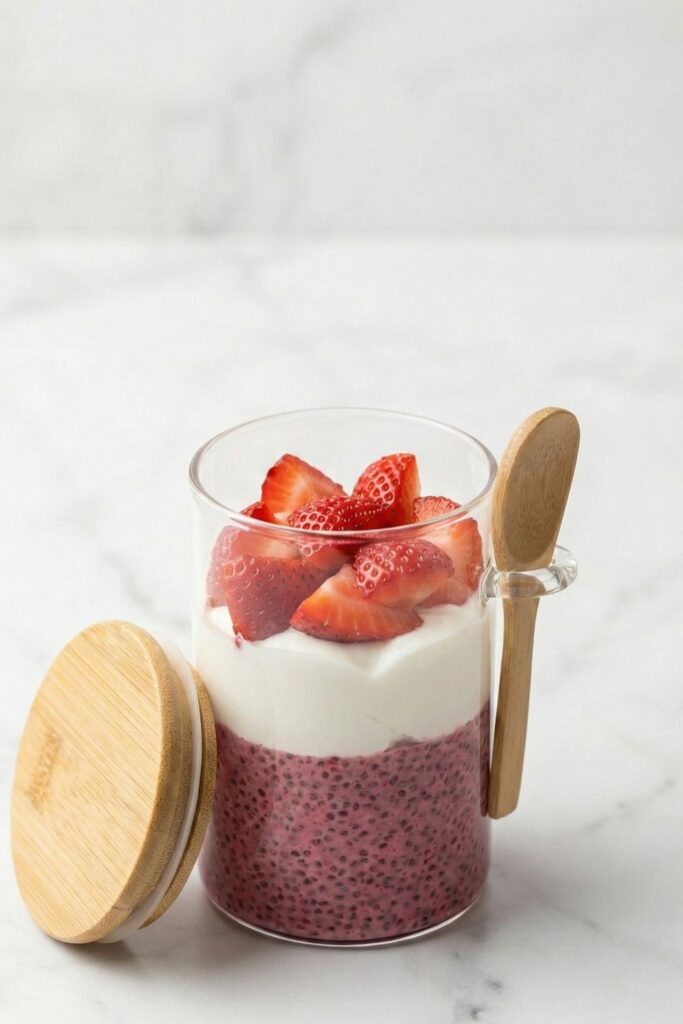
Top with fresh, chopped strawberries or raspberries. Pile them high. The red fruit should peek over the rim of the jar.
Place the bamboo lid on or slide the wooden spoon into the holder. The jar should look dense and heavy, not airy.
Troubleshooting Guide: The Viscosity Protocol
“My pudding is runny/soupy.”
- The Cause: Old seeds or insufficient time.
- The Fix: Chia seeds lose absorbency as they age. If your seeds are over 1 year old, add an extra tablespoon per batch.
- The Quick Fix: If you’ve already made it and it’s runny, stir in 1 teaspoon of psyllium husk or 1 tablespoon of extra chia seeds and wait 20 minutes.
“The seeds are all at the bottom (The Brick Effect).”
- The Cause: You skipped the “3-Minute Second Stir.“
- The Science: Without the second stir, the seeds settle before the gel matrix is strong enough to hold them against gravity.
- The Fix: Once it’s “bricked,” it is hard to fix. You can try to dump it back into a blender and pulse it to redistribute, but the texture will change to a mousse.
If you loved this High Protein Recipe do checks out my Raspberry Yogurt Bark for Insulin Stabilization there is no guilt in snacking on Abby’s health series.
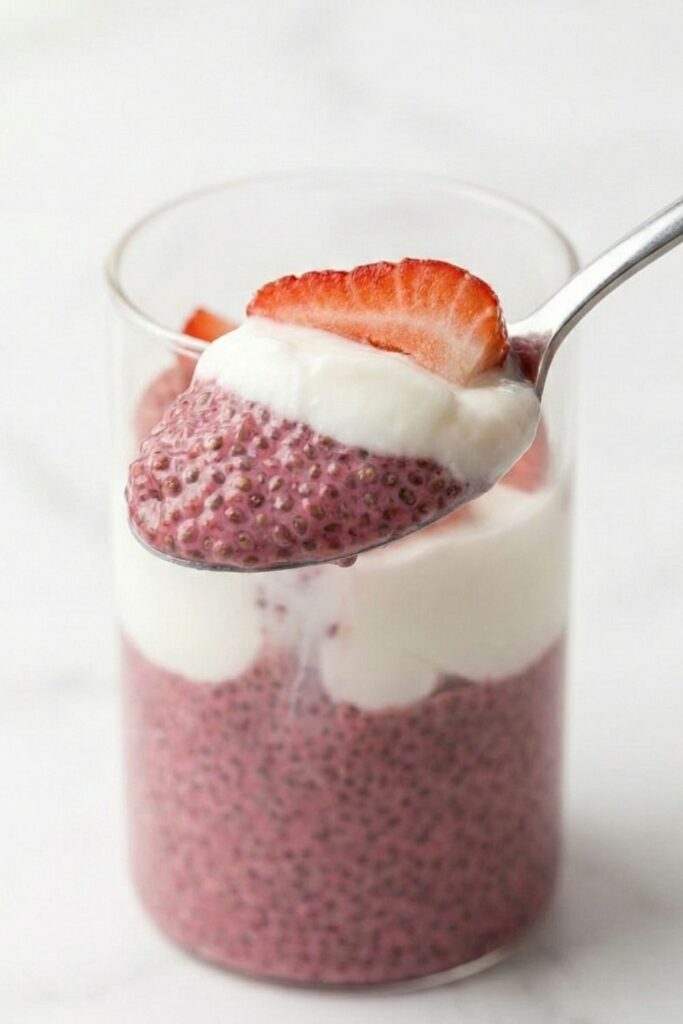
“The texture is crunchy.”
- The Cause: Under-hydration.
- The Fix: The minimum hydration time is 1 hour. The optimal hydration time is 8+ hours (overnight). For the best texture, always make this the night before.
“The yogurt layer sank into the pink layer.”
- The Cause: The pink layer wasn’t set enough, or you used a heavy hand.
- The Fix: Refrigerate the pink layer for 20 minutes before adding the white yogurt layer. This creates a “skin” on top that supports the weight of the yogurt.
Serving & Storage Logistics
Temperature:
Serve chilled. Do not heat. Heating breaks the delicate omega-3 fatty acids in the chia seeds.
Storage Life:
- Refrigerator: 5 days (Best quality in days 1-3).
- Freezer: Not recommended. The freeze-thaw cycle destroys the gel structure, turning it into a watery mess.
The “Grab-and-Go” Protocol:
Keep the lids on tight. Because of the oxidation barrier, you can meal prep 5 of these on Sunday night. By Wednesday, the texture will actually be better (softer) than on Monday.
Frequently Asked Questions (FAQ)
Technically yes, but the ratio changes. Ground flax creates a slimier texture and requires less liquid. I do not recommend it for this specific “Parfait” application as it lacks the structural integrity to hold up the yogurt layer.
Raspberries are Low-FODMAP in 60g servings. Oat milk is generally safe, but ensure it is “gum-free” if you have extreme sensitivity. This recipe is designed for Motility, so it is generally gut-friendly unless you are in an active flare-up.
If you used a “natural” oat milk without emulsifiers (like dipotassium phosphate), it may separate from the acid in the raspberries. This is aesthetic, not harmful. Shake or stir before eating.
Yes. To increase the protein count further, add 1 scoop of unflavored or vanilla whey isolate during Step 2 (The Emulsion) in the blender. Do not stir it in by hand, or it will clump.
There is no excuse for the “Afternoon Slump.”
You now have the technical blueprint to build a metabolic shield in a jar. Respect the chemistry, follow the stir protocol, and close the fiber gap.
Get to the lab (kitchen).
High-Protein Raspberry Chia Parfaits (The Metabolic Fiber Reset)

Ingredients
The Soluble Fiber Emulsion (Base)
- 1 cup 240ml Oat Milk (Unsweetened, Barista Blend preferred for viscosity)
- 1 cup 125g Frozen Raspberries (Must be frozen to rupture cell walls for better blending)
The Hydrocolloid Matrix (Thickener)
- 1/4 cup 60g Greek Yogurt (Vanilla or Plain 2%)
- 1/4 cup 45g Chia Seeds (Black or White)
The Parfait Assembly (Layers)
- 1/2 cup 120g Greek Yogurt (Thick style, for the white contrast layer)
- 1/4 cup 30g Fresh Raspberries (Dry, for topping)
Instructions
- Place the 1 cup Frozen Raspberries and 1 cup Oat Milk into your high-speed blender canister. Blend on HIGH for 30-45 seconds. Technical Cue: The mixture must be a uniform, opaque neon pink. If you see chunks, blend for another 15 seconds. We need a liquid, not a slushie.
- In a medium mixing bowl, combine the dry Chia Seeds and the first 1/4 cup of Yogurt. Pour the pink raspberry emulsion directly over them. Action: Whisk immediately and vigorously for 30 seconds. Ensure the yogurt is fully dissolved into the pink liquid and no dry seeds remain floating on top.
- Set a timer for 3 minutes. Do not touch the bowl. The Science: This pause allows the initial mucilage (gel layer) to form on the seed coat. Without this wait, the heavy seeds will sink to the bottom of the jar during storage.
- When the timer beeps, whisk the mixture again for 30 seconds. Visual Check: The consistency should now resemble pancake batter, not water. The seeds should be suspended in the liquid column, not sinking.
- Cover the bowl with plastic wrap or a lid. Place in the refrigerator for a minimum of 1 hour (Overnight / 8 hours is optimal for maximum digestibility).
- Remove the chilled pudding. It should be thick and spoonable.
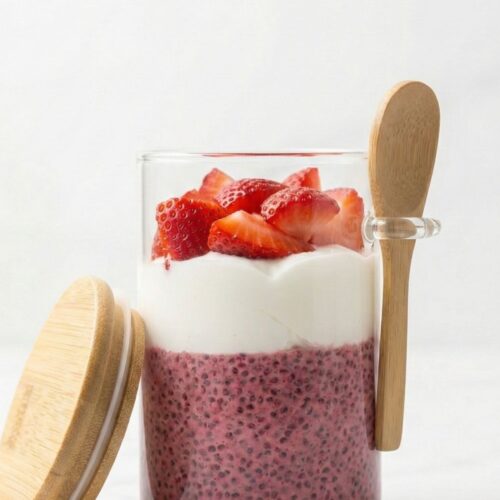
- Layer 1: Spoon the pink chia pudding into the bottom of your glass jars (fill about 60% high). Layer 2: Add the 1/2 cup Greek Yogurt on top. Smooth it out with the back of a spoon to create a stark white band (visual contrast). Layer 3: Top with Fresh Raspberries.
- Insert the wooden spoon into the holder (if applicable) and serve cold.
Notes
- The “Brick” Prevention: If you skip the Step 4 (Second Stir), your seeds will form a solid brick at the bottom of the jar. The 3-minute wait is non-negotiable for texture.
- Storage Protocol: These jars stay fresh in the fridge for up to 5 days. Do not freeze (the freeze-thaw cycle destroys the gel structure).
- Protein Boost: To hit 30g of protein, add 1 scoop of unflavored Whey Isolate during Step 1 (in the blender). Do not stir it in by hand; it will clump.
- Sensory Detail: The frozen raspberries in the base provide a sharper, more tart flavor profile than fresh ones, cutting through the creaminess of the oat milk.
Equipment
- High-Speed Blender (Minimum 1500 watts for smooth emulsion)
- 4 x 16oz Borosilicate Glass Jars (With spoon holder preferred)
- Silicone Spatula
- Digital Scale (Optional but recommended for precision)
Nutrition (Per Jar)
- Calories: 285 kcal
- Carbohydrates: 34g
- Protein: 18g
- Fat: 11g
- Fiber: 14g (50% DV)
- Sugar: 9g (Natural fruit sugar)