Systemic inflammation is the silent efficiency killer. It disrupts cortisol regulation, clouds cognitive function, and halts metabolic recovery. Most breakfasts fail because they spike glucose, triggering an immediate inflammatory response.
This is not a recipe; it is a recovery protocol.
We are engineering a meal designed to maximize Anthocyanin absorption and optimize Beta-Glucan viscosity. By strictly controlling the hydration variables and temperature states of specific ingredients, we create a vehicle for sustained energy release. This method eliminates the “glucose crash” associated with standard oatmeal and replaces it with a steady-state fuel source for your morning workflow.
This requires precision. You cannot eyeball these measurements. The chemical reaction between the chia seeds’ hydrophilic shell and the oat milk’s lipid structure depends on exact ratios. If you miss the ratio, you lose the viscosity. If you lose the viscosity, you lose the satiety benefit.
Let’s build the perfect anti-inflammatory vessel.
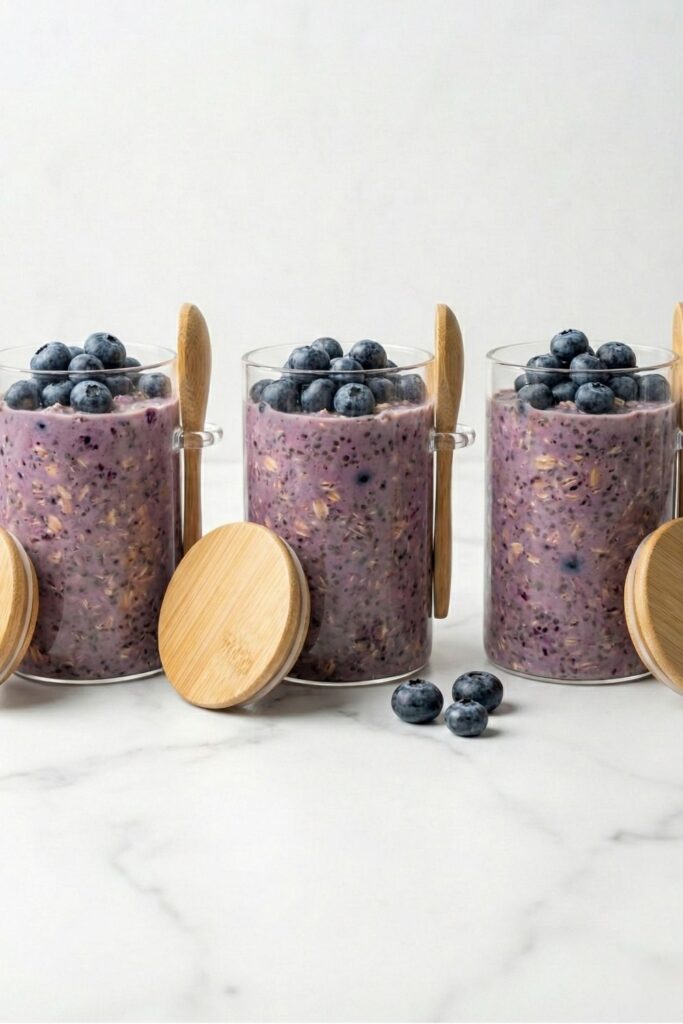
The Science: Why This Formulation Works
This protocol targets Oxidative Stress Reduction through two primary chemical mechanisms: Synergistic Fermentation and Pigment Stability.
Mechanism 1: The Anthocyanin Shield
Blueberries contain anthocyanins, powerful flavonoids responsible for their deep purple pigment. Research indicates these compounds effectively scavenge free radicals, reducing oxidative stress in neural tissue. However, anthocyanins are heat-sensitive. By utilizing the “Overnight” cold-soak method, we preserve 100% of the bioavailability that is typically destroyed during stovetop cooking. Using frozen blueberries specifically is a tactical choice; the freezing process ruptures the cell walls (lysis), making the anthocyanins more bioavailable for absorption immediately upon digestion.
Mechanism 2: Viscosity & Glycemic Control
The “Cream” component isn’t just for texture it is a lipid barrier. When the soluble fiber (Beta-Glucan) in oats hydrates, it forms a viscous gel in the gut. This gel slows gastric emptying. By layering lipids (yogurt/milk) and fiber (chia/oats), we physically coat the carbohydrate molecules. This delays the enzymatic breakdown of starches into glucose.
The result? A flat glucose curve.
Instead of an insulin spike that signals your body to store fat, you trigger a “slow-drip” energy release. This keeps inflammation markers low and mental clarity high.

Ingredient Deep Dive: The Chemical Stats
To replicate the “purple milk” reaction and the firm gel texture, you must use ingredients with specific structural properties.
1. Rolled Oats (Old Fashioned), Not Quick
- The Spec: You need the intact endosperm. Quick oats have been pre-processed and rolled too thin, destroying their structural integrity. They turn into “paste” after 6 hours.
- The Stat: Rolled oats maintain a Glycemic Index (GI) of ~55, whereas quick oats spike to ~71. We need the lower GI for the anti-inflammatory effect.
2. Chia Seeds (Salvia Hispanica)
- The Spec: These are the hydraulic engineers of the jar. They absorb up to 12 times their weight in liquid.
- The Stat: 1 tablespoon provides 5g of fiber. Without this specific volume, the oats will remain “soupy” because the oats alone cannot bind the 1 ¼ cups of liquid we are using.
3. Frozen Blueberries (The Catalyst)
- The Spec: Do not use fresh berries for the inner layer. Fresh berries have intact skins that hold the juice inside.
- The Reaction: Frozen berries leach their juices as they thaw in the fridge. This juice, rich in acids, reacts with the neutral pH of the oat milk to create the signature purple dye and infuse flavor into every grain.
4. The Liquid Solvent (Oat Milk)
- The Spec: Use a high-lipid Oat Milk or Almond Milk. Water will result in crystal formation (ice) and a bland taste. You need fat to emulsify the chia gel.
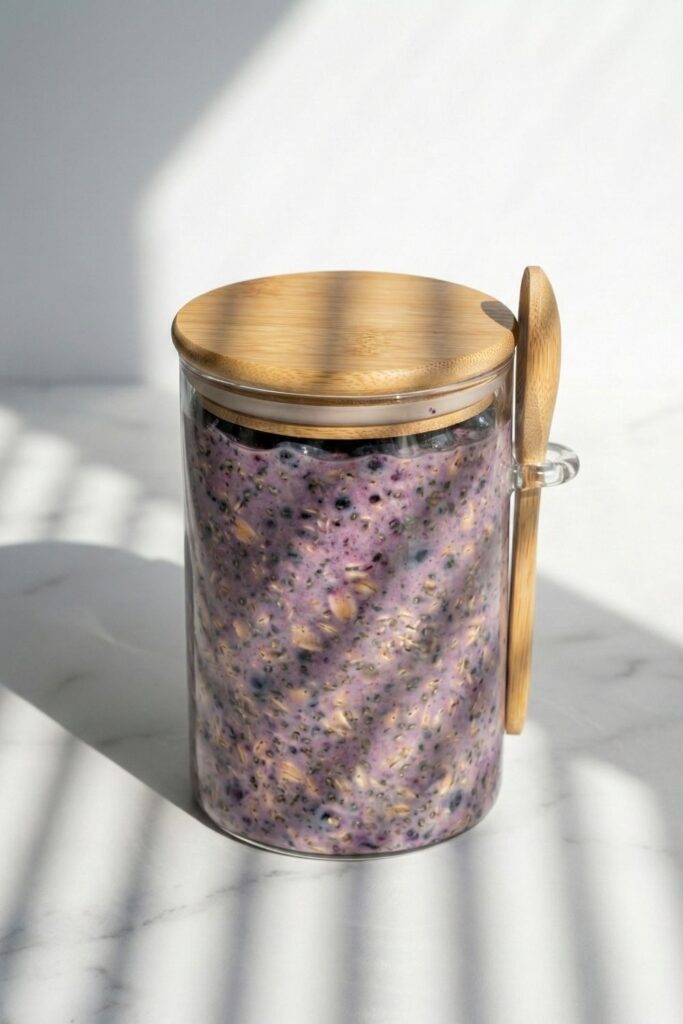
Equipment Clinic: The Hardware
Your choice of container dictates the thermal stability and mechanical mixing potential of the protocol.
The Container: 16oz Borosilicate Glass
Standard 10oz or 12oz jars are structurally inefficient for this protocol because they lack “mixing clearance.”
- The 16oz Advantage: The chemical reaction between the chia seeds and oat milk requires vigorous agitation to prevent clumping. A 16oz capacity provides the necessary vertical headspace to drive the spoon to the bottom and create a vortex without overflowing.
- Thermal Mass: The larger volume of this glass holds the cold temperature longer once removed from the fridge, preserving the texture during consumption.
The Seal: Bamboo with Silicone Ring
Oxygen is the enemy. If your jar is not airtight, the oats will absorb “fridge flavors” (onions, leftovers). The silicone ring creates a vacuum seal, ensuring the fermentation process happens in a sterile, anaerobic environment.
The Tool: Integrated Spoon Loop
Your unit includes a dedicated spoon loop.
- Protocol: Do not store the spoon in the loop while in the fridge if the shelf height is tight. However, this feature is critical for the “Grab-and-Go” workflow, eliminating the friction of searching for silverware in the morning.
Step-by-Step: The Assembly Protocol
Follow this strict layering order. Do not mix in a bowl. Build directly in the vessel to maintain the stratification.
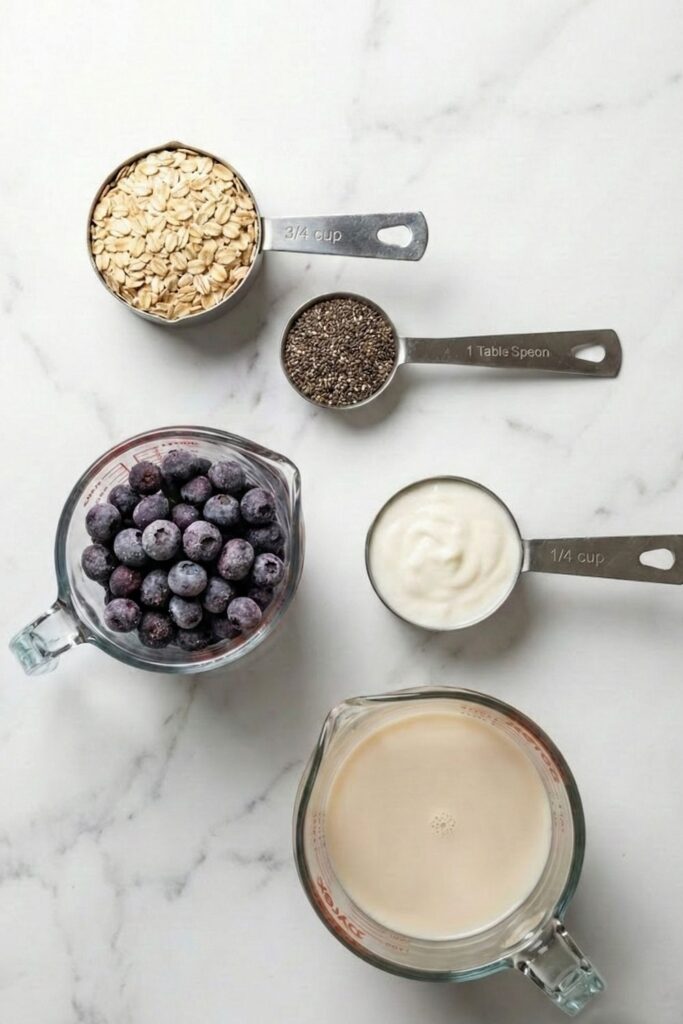
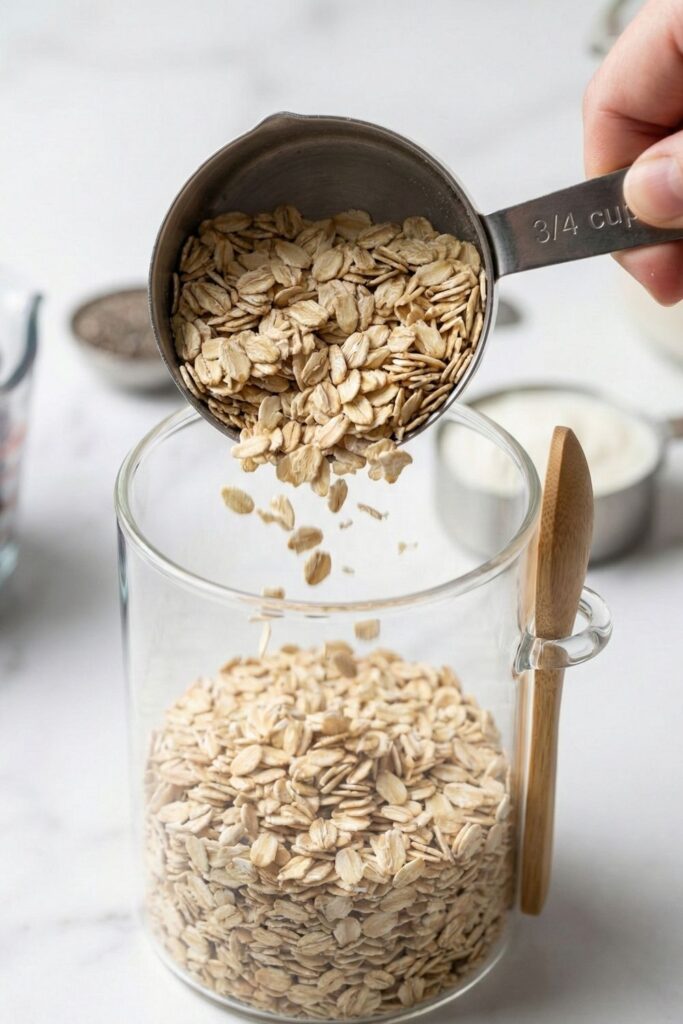
Place your 16oz glass jar on a flat surface. Pour the ¾ cup Old Fashioned Oats directly into the bottom. Ensure they are level.
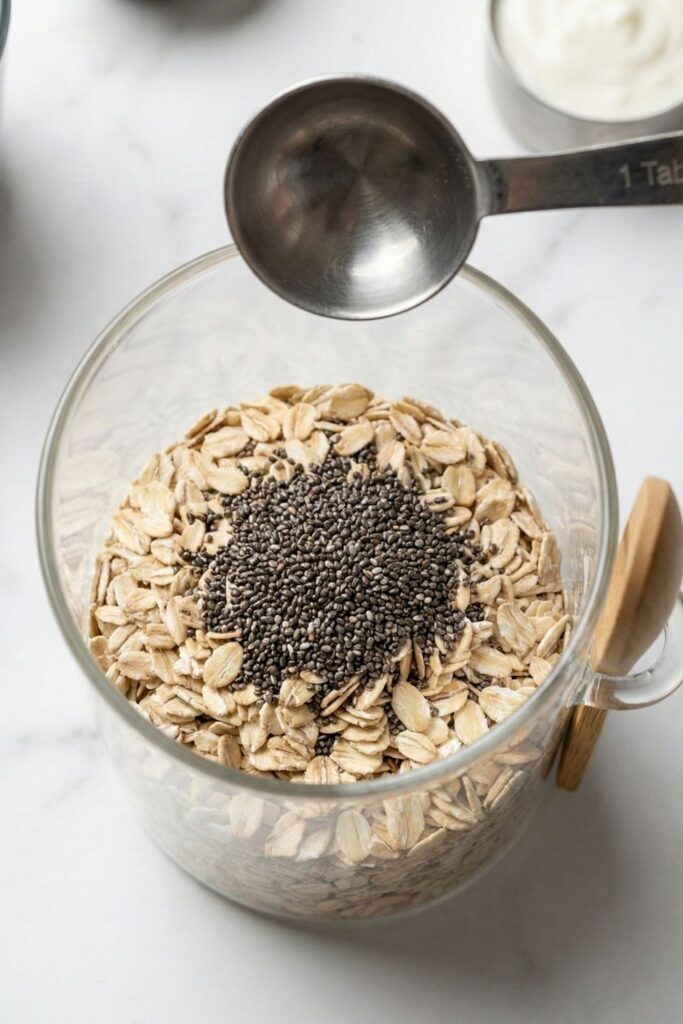
Add 1 tablespoon of Chia Seeds directly on top of the dry oats.
- Critical Check: Do not stir yet. We want to verify the measurement before adding liquid. If you forget this step, the recipe fails.
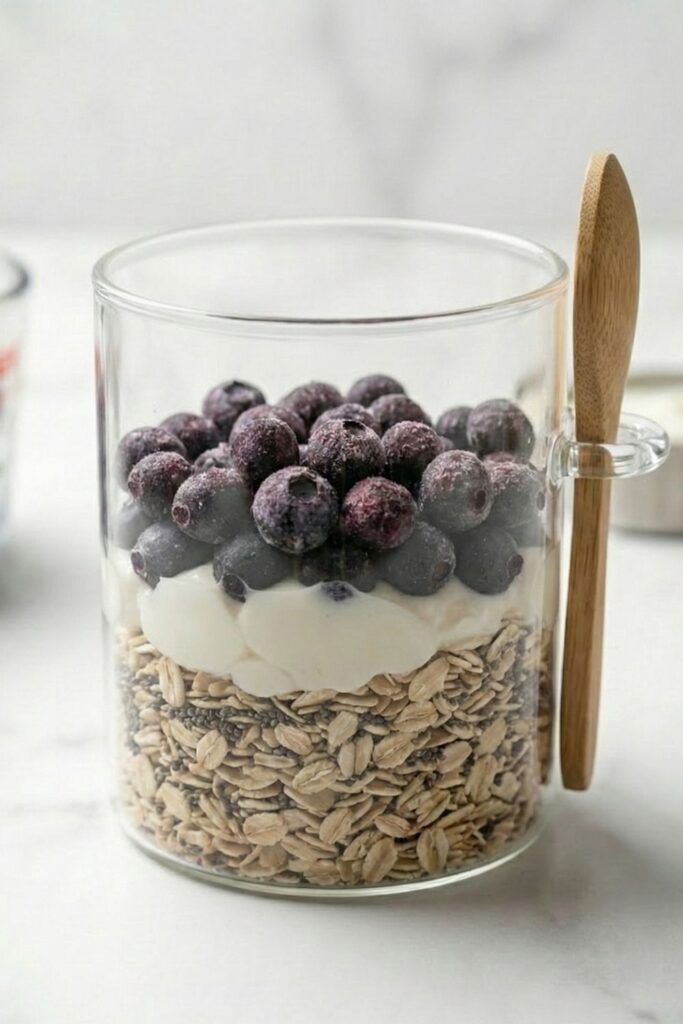
Dollop 2 tbsp of Vanilla Yogurt onto the seeds. Then, pour in 1 cup of Frozen Blueberries.
- Observation: Notice the frost on the berries? That is essential. As that frost melts, it becomes the water source that dyes the milk.
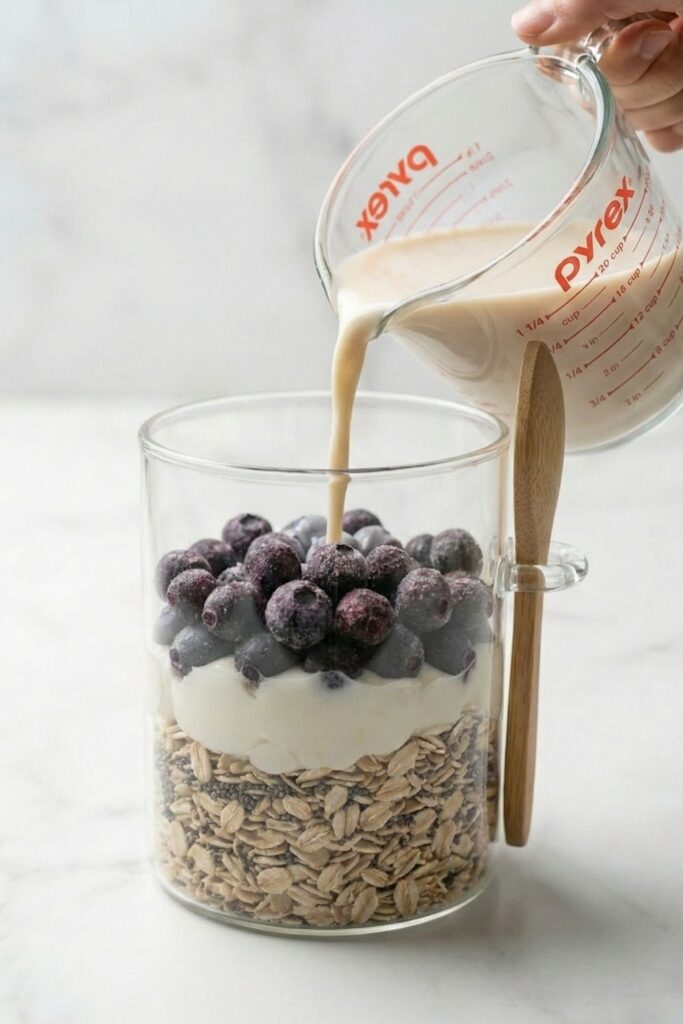
Pour 1 ¼ cups of Oat Milk over the entire mixture.
- Technique: Pour slowly over the berries to avoid splashing. Fill until the liquid line is just below the rim of the jar.
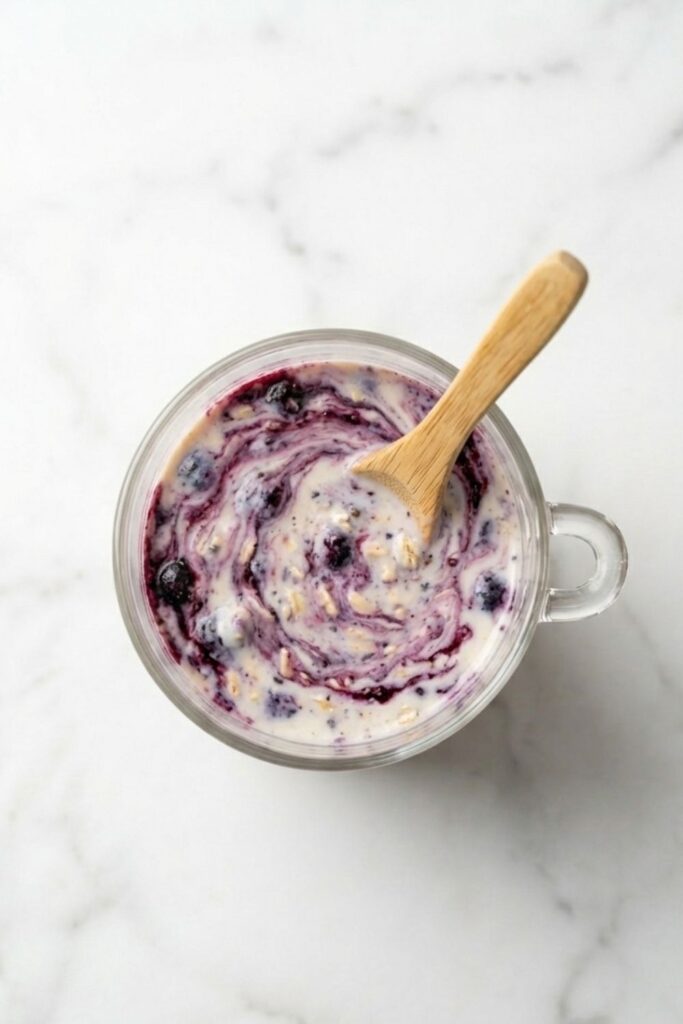
Insert your spoon to the very bottom. Agitate vigorously.
Watch the color change. You are looking for an immediate shift from white to lavender/purple. This confirms the frozen berries are reacting with the liquid. Break up the yogurt clump so it disperses evenly.
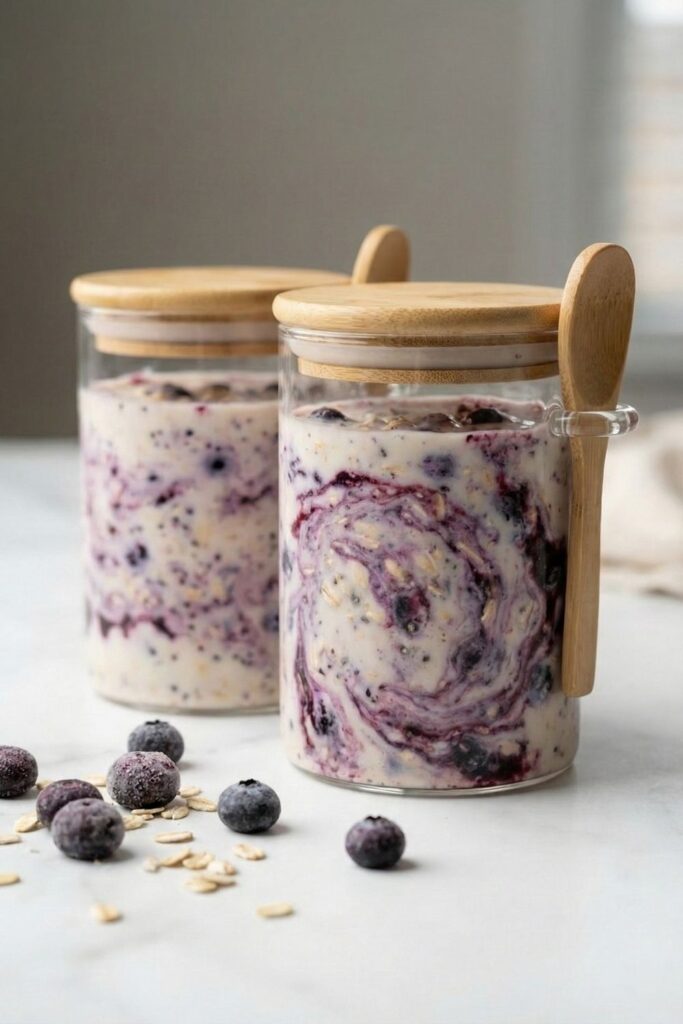
Wipe the rim of the jar. Screw the bamboo lid on tightly.
Place in the refrigerator (35°F – 38°F) for a minimum of 6 hours. Do not cheat this time. The beta-glucan needs time to unfurl.
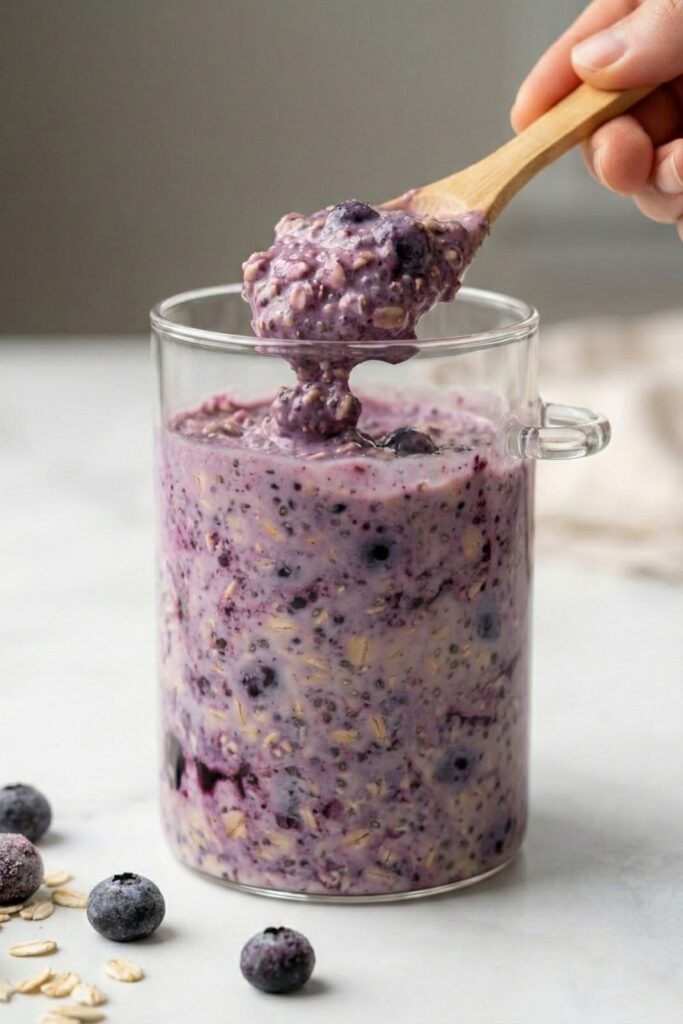
After 6 hours, open the jar. The mixture should be set no loose liquid.
When you lift a spoonful, it should hold its shape. If it runs off the spoon like water, the chia seeds were old or the measurement was off.
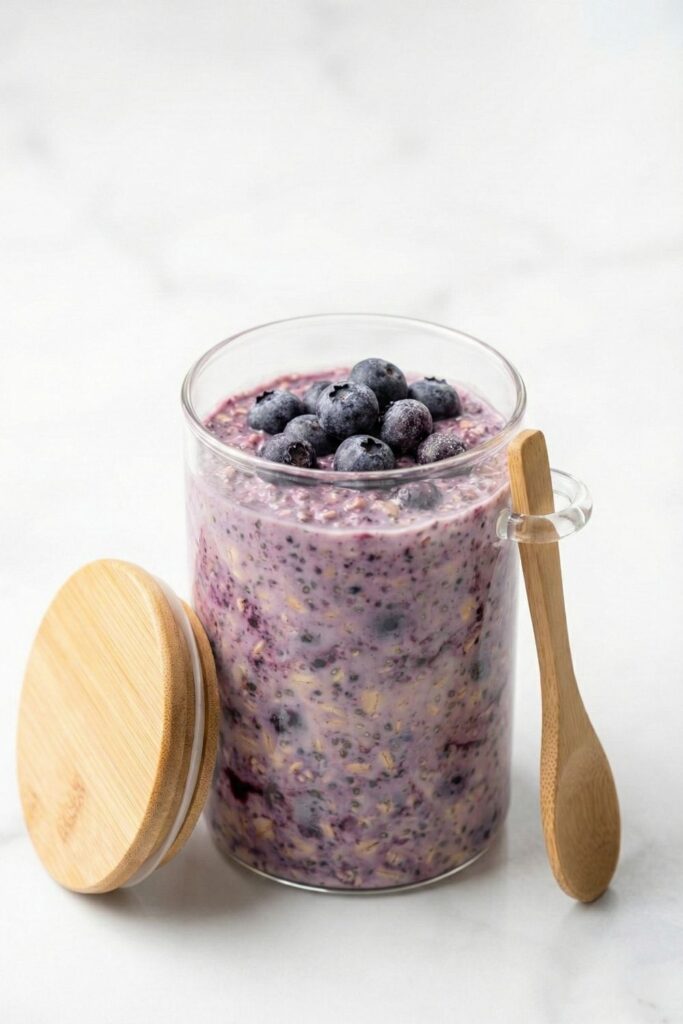
Top with a fresh “cap” of yogurt and fresh blueberries or just the fresh blueberries for that crisp “snap” texture against the soft oats.(Optional)
if you love recipes like this check out my High-Protein Raspberry Chia Parfaits
Troubleshooting: Why Did It Fail?
Even with a manual, variables can shift. Here is how to diagnose structural failures in your batch.
The Mixture is “Soupy” or Runny.
- Cause A: Old Chia Seeds. Chia seeds lose their mucilaginous properties over time. If your seeds are >1 year old, they won’t gel.
- Cause B: Wrong Oats. You used Steel Cut Oats. They are too dense to absorb liquid cold. They require heat.
- The Fix: Stir in 1 teaspoon of ground flaxseed and wait 30 minutes.
The Texture is “Chalky” or Dry.
- Cause: Protein Powder Absorption. Did you add a scoop of protein powder? Powders are desiccants. They steal water from the oats.
- The Fix: If you add protein powder, you must increase the liquid by ¼ cup per scoop.
No Purple Color
- Cause: Fresh Berries. You used fresh berries inside the mix. Fresh skins are waterproof.
- The Fix: Use frozen berries for the soak, fresh berries for the topping. Always.
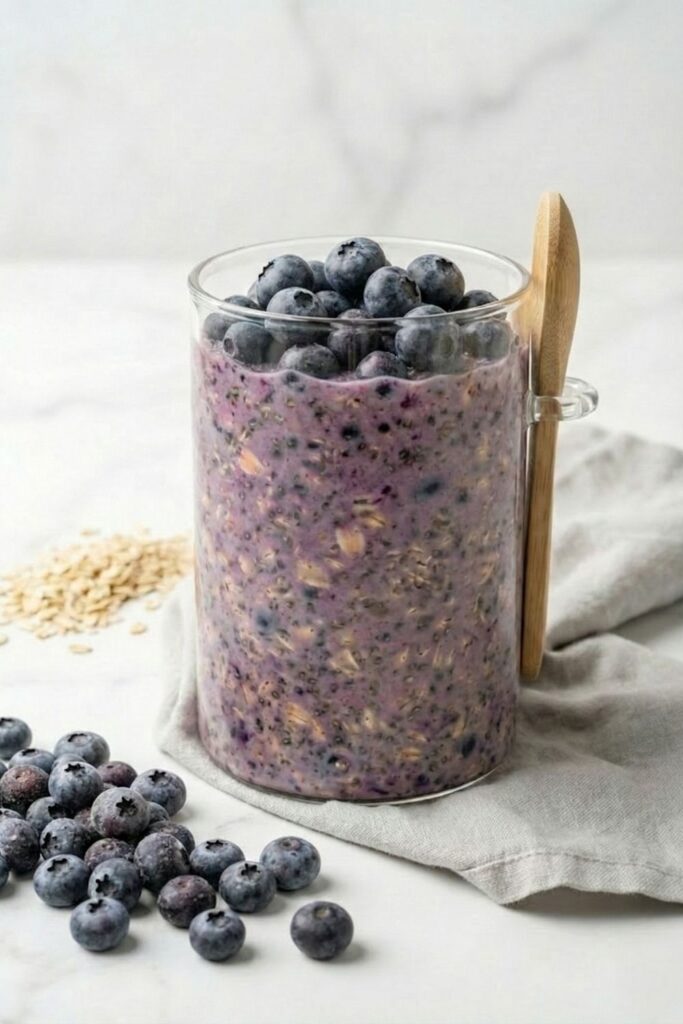
Serving & Storage Protocols
Shelf Life (The Safety Zone):
This protocol is stable for 4 days in the refrigerator.
- Day 1-2: Peak texture. Creamy and firm.
- Day 3: Softer texture, oats begin to break down further (easier digestion).
- Day 4: Maximum limit. Acid profile from the berries may begin to sour the milk.
Serving Temperature:
Serve cold directly from the fridge. Do not heat. Heating destroys the raw starch structure (resistant starch) which serves as food for your gut microbiome.
The Transport Protocol:
If taking this to work, ensure the lid is tight. The bamboo lids are aesthetic but can loosen if the silicone ring is wet. Wipe the ring dry before sealing.
Frequently Asked Questions
Technically, yes. Functionally, no. Water lacks the lipids required to carry the flavor. The result will be icy and flavorless. You need the fat content of a milk alternative to mimic the “Cream” profile.
No. They release water, but the chia seeds are calculated specifically to absorb that excess moisture. The balance is zero-sum.
Density. If you add the top garnish layer before the oats have set (liquid state), it will sink. Always add the “aesthetic” top layer after the 6-hour incubation period, right before you eat.
Oats are too high in carbohydrates for strict Keto. However, for a “Low Glycemic” or “Slow Carb” protocol, this is ideal due to the fiber blunting the insulin response.
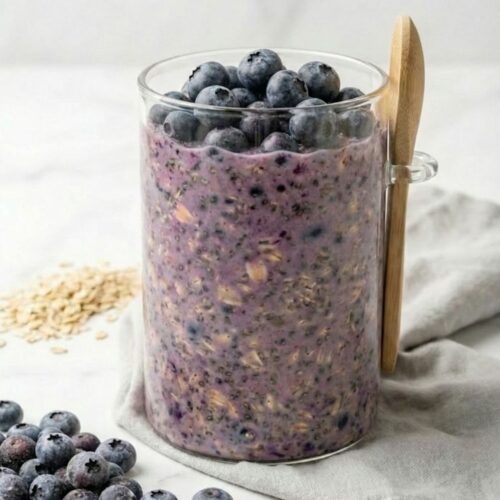
Anti-Inflammatory Blueberry & Cream Overnight Oats (Metabolic Recovery Protocol)

Ingredients
The Solid State (Dry & Frozen)
- ¾ cup Old Fashioned Rolled Oats Do not use Quick or Steel Cut
- 1 tbsp Chia Seeds Black or White
- 1 cup Frozen Blueberries Must be frozen for pigment reaction
The Liquid State (Wet)
- ¼ cup Vanilla Greek Yogurt Plus 2 tbsp extra for “Cap” garnish
- 1 ¼ cups Oat Milk Unsweetened or Vanilla
The Garnish (Post-Incubation)
- Handful Fresh Blueberries For texture contrast
Instructions
The Dry Assembly
- Sanitize: Ensure your 16oz Borosilicate Glass Jars are clean and dry.
- Base Layer: Distribute the ¾ cup Old Fashioned Oats evenly between the two jars.
- Binder Application: Add ½ tablespoon of Chia Seeds to each jar (1 tbsp total). Critical: Do not mix yet. Verify the seeds are present.
The Lipid Integration
- Emulsifier: Add 2 tablespoons of Vanilla Yogurt directly onto the dry oats in each jar.
- Pigment Loading: Pour ½ cup of Frozen Blueberries into each jar. Do not use fresh berries here; the ice crystals are required for the color reaction.
Hydration & Agitation
- Solvent Pour: Pour approx. ½ cup + 2 tbsp of Oat Milk into each jar (dividing the 1 ¼ cup total evenly). Fill until the liquid just covers the frozen berries.
- The Agitation: Insert spoon to the bottom. Mix vigorously for 15 seconds. Ensure the yogurt dollop is fully dispersed and the milk turns purple.
Incubation
- Seal: Wipe the rim. Secure the bamboo lid tightly to create an anaerobic seal.
- Time: Refrigerate for a minimum of 6 hours (overnight is optimal). This allows the beta-glucan to gelatinize.
The Service Protocol
- Verify: Open the jar. The texture should be semi-solid and hold a spoon upright.
- Garnish: Top with an additional tablespoon of yogurt (the “Cap”) and fresh blueberries or just blueberries for a textural “pop” before consuming.
Notes
- Metric Precision: Do not eyeball the Chia Seeds. If you use less than 1 tablespoon, the mixture will remain liquid (failure state). If you use more, it will become solid/rubbery.
- Thermal Physics: We use Frozen Blueberries for the internal soak because the freezing process ruptures the cell walls, releasing 100% of the anthocyanin pigment into the oats. We use Fresh Blueberries on top for the structural crunch.
- The 16oz Advantage: Using a 16oz jar allows for “Headspace.” This prevents the milk from overflowing during the agitation (mixing) phase, ensuring a clean seal.
- Shelf Life: This protocol is stable in the refrigerator for 4 days. Do not freeze the finished product.
Equipment
- 16oz Borosilicate Glass Jars (with Bamboo Lids)
- Digital Kitchen Scale (Optional for precision)
Nutrition (Per Jar)
- Serving Size: 1 Jar (approx. 300g)
- Calories: 288 kcal
- Carbohydrates: 48g
- Protein: 8g
- Fat: 7g
- Fiber: 9g (High Efficiency)
- Sugar: 12g (Natural Fructose)